https://www.youtube.com/watch?v=sWFSZR4uZ0w
Saturday, February 2, 2019

Saturday, January 26, 2019
The Passage
Great film about two brothers who were some of the earliest modern paddlers to do the inside passage.
https://youtu.be/kie-a5q8bIE
https://youtu.be/kie-a5q8bIE
Monday, December 24, 2018
Sunday, August 12, 2018
I Bough a Savage River Falcon
 |
| My new Savage River Falcon ready for its maiden voyage. |
Sometime last year I started talking with John Diller, owner of Savage River. They make canoes and other paddle craft. He had developed two new canoes capable of being used for the WaterTribe Everglades Challenge, the solo Falcon and the tandem Osprey. This peaked my interest but being one who plans way ahead I was already committed to doing the race with my daughter in a boat we both know well. Using a Savage River canoe with no seat time in the March 2018 event wasn't something I was comfortable doing. John, interested in the challenge, drove down for the start with a Falcon and Osprey in tow. We chatted some more and I took the Falcon out for a test paddle. I liked it. It fit a gap in my current stable of boats. I saw it as one that could do marathon distances, regular workouts, and local short races. By April I put in an order for a new boat with the intention of using it in the 2018 Everglades Challenge.
Over the course of next couple months John and I worked out the details. Stuff like layup, cockpit size, coaming measurements, rudder configuration, and other little details. I would say, "John, build me a Savage River designed boat and I will paddle it." John would answer, "All my boats are custom." There was truth in that. Savage River is not your run of the mill canoe manufacture pumping out overweight recreational boats. John and his company make hand crafted high end boats out of space age materials using the latest techniques meant to reduce weight and maximize strength. They are primarily known for racing canoes. Go to the website for the biggest race in the country, https://www.ausablecanoemarathon.org/, and you will spot his logo on many of the boats in the pictures. When I go to my local events run by Florida Competition Paddlers Association (FCPA) several of the fastest single blade paddlers are paddling Savage River canoes.
 |
| My boat still in the mold. Outer layer is carbon. Inside is Kevlar. |
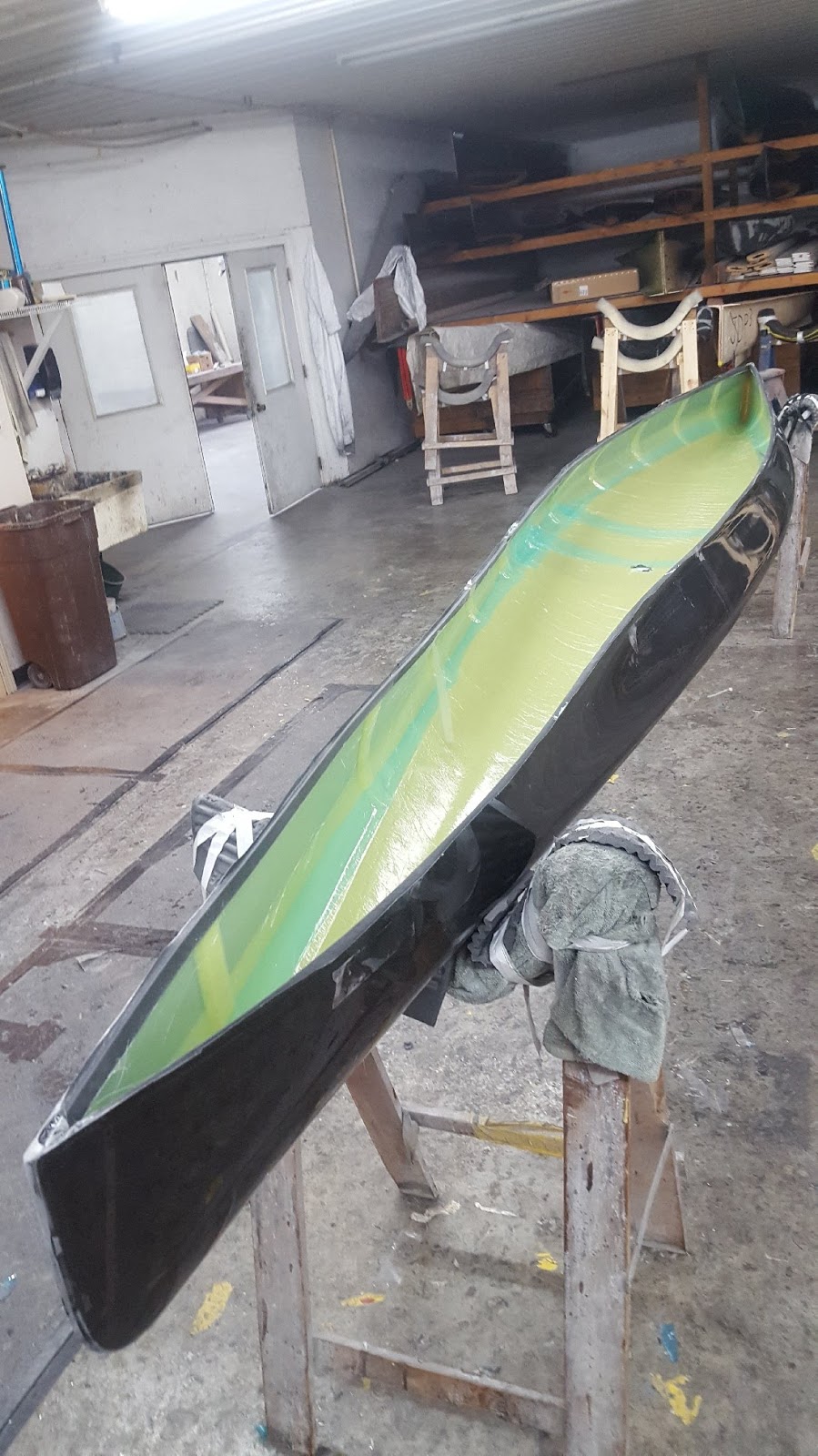 |
| Hull without the deck installed. |
 |
| John working on the final details. |
I learned that Savage River builds quite a few boat each year. A few months went by as they built other boats that were ordered before mine. Now, here in mid August I am the exited to own my own new boat. Saturday I switched out the stock rudder cables for Dyneema, which is a lighter high strength fiber line.
 |
| The cockpit and coaming. |
This morning I dropped the boat in my local river and went for my first paddle. Here are my first thoughts. The Savage River has a highly adjustable seat. You can go forward and aft or up and down. I started with the seat in the highest position but quickly decided I wanted it down in the 2nd highest position. I set the seat position forward/aft to the balance point where I was holding the boat after taking it down from my truck. This was a good first guess but I may slide it a bit more forward when carrying a multi day load of gear since most of it will be in the aft section. Why aft? Unlike my other boats the Falcon is asymmetrical. Its wider in the stern than the bow. It give the boat a narrow entry and look to it but the volume in the stern is surprisingly large. The beam of the boat is narrower than my other expedition canoes but still very comfortable.
When having the boat built I asked John to to make the gunwale, coaming high, and coaming width the maximum that would work this hull design. The though being that I wanted the boat to be as seaworthy as possible for the Everglades Challenge. I am very happy with the way it turned out.
 |
| Here I am with my Savage River Falcon in the water for the first time. Balance and seat hight felt good. |
Sliding the boat into the water was a joy due to the boat weighing 36 1/2 lbs. Easing into the seat I was pleasantly surprised by the initial stability with a light load. The Smart Track rudder was doing its job well too. I took off on a 5 mile test run in protected water. Speed felt good and while out of my training routine due to a hectic work schedule I felt good pushing the pace. 4.5 to 6 mph speeds were the norm for me but there was a light current helping those numbers out. The boat felt more than fast enough for me to be able to put in 45 - 60 miles a day during a WaterTribe event.
I am exited to be in a new Falcon. I will share more as I start adding some rigging, training, and hitting some local events. If you want to learn more about the boat you can check it out here: Savage River Falcon
Saturday, March 31, 2018
Mississippi By Canoe
One of the best made canoe films I
have run across. This is what you get when a retired journalist sets
out on an expedition.
https://www.youtube.com/watch?v=2aoFVA1vmPs
https://www.youtube.com/watch?v=2aoFVA1vmPs
Wednesday, January 3, 2018
Sailing Zatara
This is a YouTube series about a family that sold their house and are sailing around the world. They begin with no sailing experience. The videos share what they learn and experience along the way. They are about 1/2 way through at the time of this post. Very well done episodes.
Saturday, December 30, 2017
The Basics of How to Rig a Sea Pearl by Out-Island Explorers
Good video for anyone looking for a Sea Pearl 21
Friday, December 29, 2017
Setting Up A Sea Pearl for Camping
Great article originally posted on seapearlboats.org and recovered using archive.org
How to go Cruising in Comfort in a Small Boat
By Ron Hoddinott for Small Craft Advisory

The purpose of this article is to explain as clearly as possible, how to take a small open boat, or mini-cruiser, and go cruising for a week or more, and be comfortable and happy for the entire trip. In order to successfully do this, you must be well organized, well prepared, and be willing to adapt to your new environment during the duration of the trip. The benefits of doing so far outweigh the tradeoffs that you must make in the process. The shorelines, sunsets, secret coves, communion with wildlife, sense of self-discovery and inner-peace are all benefits of taking the road less traveled in a small boat with shallow draft into the wilderness.
But how is it possible to safely and comfortably do, in such a small shallow craft, what many feel requires a larger and more substantial vessel? Following in the wakes of Shane St. Claire, who circumnavigated the eastern United States in six months in a SeaPearl 21, and Frank and Margaret Dye who taught everyone that the size of the craft is not a complete measure of its seaworthiness, I discovered, by occasionally dispensing with “accepted wisdom”, how this is possible and even fun.
To begin with, I believe that in most, but certainly not every small boat, the potential for a shoal water cruiser exists. Beyond the necessity for seaworthiness and shallow draft, the essentials are:
Nothing can make a sailor more likely to cut his cruise short and go home than a lack of comfortable sleeping accommodations. Waking up with a backache and sore shoulders is a difficult way to start a cruise. A dry comfortable bunk with good ventilation and enough length and breath to stretch out and roll over is a first essential for a cruising boat.
For boats that lack traditional bunks down below, the ability to lie down full length depends in part on the shape of the bottom of the inside of the hull, or floor of the boat. Boats such as the Flying Scott, while great sailing boats, make sleeping aboard difficult, since there is no flat floor to lie down on. The floor features the same shapely curves as the hull. This does not make the Flying Scott unusable as an open boat cruiser, but the owners would have to make some arrangement of folding boards to create a flat spot to sleep on, perhaps between the seats. A small tent could then be erected on this folding platform.
A boat with a flat floor or hull shape makes it easy to create a sleeping area with little additional creativity. The Nimble Bay Hen, for example, has a flat floor with a folding sleeping mat as a popular option. The Dovekie has a completely flat floor (and hull), which is quite large enough to two large people to unfold self inflating air mattresses or other form of pad. The Wayfarer dinghy also features flat floorboards. The early SeaPearls had no water ballast tanks, and many of those boats are still around. With no ballast tanks the boat had a larger interior, but the floor was not completely flat except in the center of the floor. Two people could sleep below comfortably, as there was a lot more shoulder room under the side decks. With the introduction of ballast tanks, the SeaPearl has become a better cruiser for one, but two can still sleep aboard in a pinch. The ballast tanks are on both sides of the center cockpit, and there is a space between them covered with teak and holly sole boards. This design provides a perfectly flat area from side to side, and had the added advantages of creating a perfect storage area under the sole boards, and getting you above any water that may find itself below. Having a place to lie down isn’t the same as having a sleeping system that is both comfortable and easy to stow. Easy to stow can take several approaches. The first approach is the obvious: that your sleeping gear folds, rolls, or stuffs easily into dry bags that can then be stowed below. The other approach is that the sleeping gear, or part of it, can serve other uses aboard your vessel. For example, after a few years of cruising with the backpacker’s self-inflating air mattress, I got tired of tediously rolling it up and stuffing it laboriously back into it’s stuff sack each morning. I was worn out when that struggle was finished, and I had no place to lie down for a rest! A Sierra Club guide who also sails a SeaPearl, gave me a Sport-a-Seat to try, and I soon realized that it could serve as both very comfortable seat, and when folded flat, a great sleeping pad. All I had to add was a seat cushion down by my feet. The Sport-a-Seat is not inexpensive, but I can attest that it is rugged. It features Sunbrella material in several colors, and an internal ratchet hinge that allows you to set the angle of the back at any angle from 90 to 180 degrees. Sport-a-Seats are available at Boat US and West Marine for about 100 dollars. Now when I awake, I first lift the seat into an upright position, and then, comfortably seated below, I can leisurely stuff my synthetic fiber sleeping bag, into its stuff sack and then into a number 20 Seal Line dry bag.
Another innovation that I have employed is a device called the Pac-Mate, although similar devices are now marketed under different names including Coleman. Pac-Mate is a flat plastic envelope that has a zip lock seal on the opening, and one-way valves for air to escape on the opposite end. I personally have a hard time falling asleep without a real pillow. The tiny “camp pillows” that backpackers use just do not work for me. So, into the large size Pac-Mate, went my favorite pillow. It’s amazing what a small compact package a pillow becomes when all the air is squeezed out of it. It’s now a compact package that is also protected from spray or rain. It can then be rolled up and secured with a strap or line before being stowed below.
Most of us enjoy sleeping aboard when the weather requires a sleeping bag to stay cool. It’s always easier to stay warm than cool off when the weather is too hot to sleep comfortably. When selecting a sleeping bag, don’t just go to your local department store and select the cheapest bag available. There are different styles of bags, and different materials. The less expensive ones are really for the car/tent campers, or teenage sleepovers. They won’t hold up under tough use, and their worst characteristic is that they are too bulky for use on most small sailboats.
You never want to try to sleep in a wet sleeping bag. That fact prompted me to find a sleeping bag that would fit into the largest dry bag that could be stowed easily aboard Whisper. This turned out to be a number 20 see-through Seal Line bag. These are tough and absolutely water tight bags when closed properly. I found my sleeping bag in a sporting goods store that specializes in backpacking. It has a quality stuff sack (Don’t roll it up! just stuff it!) and slips easily into the dry bag. While there, I realized the amazing amount of cross over in the equipment needed for backpacking and camp cruising. We can use a lot of the same equipment. We just don’t have to carry it all on our back!
Once you have the sleeping gear worked out, and lacking a permanent cabin overhead, you have to have some kind of convertible cabin or tent that will keep the rain and spray out of your boat. There are all kinds of possible ways to accomplish this goal. The best option is probably to go ahead and have a marine sewing company create a dodger type of cabin which can be used while sailing, or when anchored.
Consider tying it in with a bimini top. Don’t forget that it should have screens and perhaps even plastic windows to let in some light. If this expense is beyond your means, look into finding a quality tent that will cover your sleeping area aboard. I recommend a tent with aluminum poles. These tents are usually 3 or 4 season rated, and will stand up to a greater amount of wind. Some boaters will set up a series of connected boards between the seats to create a flat area for the tent, while others boats will use the tent with the bottom cut out and utilize the floor of the cockpit to set up camp.Another possibility is a simple boom tent. You can prop up the boom with a topping lift, or better yet a boom crutch or gallows. This can be a simple pup tent stretched over the boom, or it could be an elaborate tent with poles to create a true cabin aboard. A line running completely around the boat under the gunnel can be used to secure the tent. The tent could have Velcro tabs sewn around its perimeter to loop around the line and adjust for tension. If at all possible, use quality marine materials, like Sunbrella, which is a synthetic material that breathes and can be made watertight with occasion treatments of Camp Dry or some similar preparation. Plastic tarp like materials are inexpensive, but have several negatives to consider. They are noisy, and they don’t breathe. Under a tent made of plastic, you would have enough condensation in the morning to experience the unique “interior rain” phenomenon.
Don’t forget, if you can’t use it when sailing, you still have to keep your gear dry underway, somehow. A tonneau cover may suffice, depending on your cockpit shape.The SeaPearl has an optional folding cabin with screens and plastic windows. This Sunbrella cabin offers sitting headroom below, is well made, and snaps into place quickly with very little work. I can sail with it up, or down, depending on the weather, or expectation of taking water aboard. It is dry below in a downpour. The forward cockpit area of the SeaPearl, under the folding cabin is 7 feet long, and the floor is perfectly flat, with three long teak and holly sole boards bridging the space between the built in water ballast tanks on either side. On either side of this cockpit are teak railings, which can hold things from rolling around. There is storage under the bridgedeck and under the forward deck as well. Although two can sleep aboard the SeaPearl 21, it doesn’t leave room for much moving about, and some stowed items would have to be moved out into the cockpit. Not a good idea in inclement weather or when marauding raccoons could find a way aboard. On the other hand, if one had to sleep two aboard, a boom tent for the mizzen boom, can be made, with screens for ventilation, and boards can be set up between the cockpit seats. Long time SeaPearl sailor Dick Shepard made such a “back porch” arrangement for his SeaPearl, and claims it works quite well.
Other SeaPearlers have adapted aluminum framed tents to the open forward cockpit of the SeaPearl with varied results. Most of these arrangements do not allow the sailor to use the shelter while under way, but in some cases offer a larger space below when anchored. It is a trade off, but I think the space below with the standard cabin is adequate, and the benefit of using it under way is priceless. You cannot always be certain that you won’t get a shower while on a passage to the next island, and although a tonneau cover for this area is available, once it is fastened down, you cannot as easily reach in or duck below to grab a sandwich, your binoculars, or jacket.
The above discussion might beg the question, “Why not just camp ashore?” This is indeed occasionally an option, however it needs to be recognized that in today’s world, fewer and fewer places that otherwise offer great sailing have a shore line where you can just pull up and camp. Even in the public areas, there are most often defined campsites, which may or may not be available, and may or may not be right along the shore. With proper planning and permits, and the correct selection of cruising destination the camp ashore method is possible. But you will not always be able to find public campsites where you want to cruise, which offers you two choices, camp illegally or camp on your boat. I prefer to stay aboard whenever possible. I’m completely self contained, and do not have to unload and re-load camping gear to “make camp.” My camp is made when I cast off from the dock.
Food Storage and Preparation
For a cruise of any duration, it is of course necessary to bring enough food to sustain yourself and your crew, and have a means to prepare the food and clean up afterwards. Your basic food preparation needs can be met with a simple one burner stove, a one quart pot, a small tea pot to heat and pour water safely, a small frying pan, and a small assortment of implements, such as a plastic spatula, large spoon, and one knife, fork and spoon for each person aboard. In addition, I carry a medium sized plastic washtub which doubles as dish washing sink and personal wash basin.To find a place for food storage, I took measurements of the depth and width of the space in the bilge, under the three sole boards in the forward cockpit, and went looking for well made watertight storage boxes that would just fit in the space provided. With tape measure in hand I haunted the department stores until I located just the right Rubbermaid product. It would hold a dozen or more small canned food products, had a snap on watertight lid, and would snap into the space below the floor. I purchased three of them. More about what goes into them below. In addition to these storage boxes, I carry a small ice chest for perishable foods that just fits up under the forward deck. In Florida, ice lasts between one and three days, depending on the weather, but to help it last longer, freeze a water storage bottle a day ahead of the trip, and place this in the ice chest. As it melts it makes a great source of cold water for drinking.
To find a location for storage of food aboard your boat, look at any built in lockers first. Heavy items should be placed as low in the bilge as possible. This becomes additional ballast, an added benefit for a light vessel. Even if you have lockers to store your food, I recommend putting your food into rugged plastic boxes that can take a beating, and protect their contents. Cans carelessly thrown into the bilge can come up battered and without labels, leaving you to wonder if you’re opening beans or peaches, and disappointed fifty percent of the time. Old time ocean sailors resorted to removing these labels, and writing the names of the contents on the cans with permanent markers. You shouldn’t have to go to that extreme. Don’t forget water. You will need between one quart and one-half gallon of water per person per day, depending on what other liquids you are drinking. Water storage is also quite heavy, so should be stowed down low in the boat. Even if your boat has a built in water tank, consider bringing some sturdy water containers of equal volume. Don’t buy the one gallon jugs available in grocery stores, as they are quite fragile and will leak all over your sleeping gear, ruining your trip. Years ago I was able to obtain 1 liter plastic bottles from a hospital supply that used them for saline solution drips. They are very rugged and rectangular to help in storage. If you can’t find these, then consider purchasing the secure and well made Nalgene bottles. Short of that just bring a lot of the 12 ounce water bottles that can be purchased everywhere. A 2.5 gallon plastic water storage barrel with gravity fed spigot is also carried aboard Whisper when cruising for more than a few days.
The subject of stove fuel comes up quite often among cruising folk. It is well known that a non-pressurized alcohol stove is probably the safest, but it is also one of the slowest fuels to heat water, and can be messy to pour and store aboard. Propane, although a hot fuel, is bulky compared with other fuels, and is somewhat dangerous as the fumes are heavier than air, and can gather in the bilge. Kerosene or white gas are, in my opinion too dangerous to use aboard a boat, and pouring the liquid from container to stove can be problematic on board. This is an area where the backpacker’s concern for light weight are of no help to us. Backpacker’s stoves that use various fuels or multi-fuels, are very light and fold up into small packages. But they do not have substantial enough bases to support a pot sufficiently should you want to cook aboard while anchored in choppy water, or while being rocked by powerboat wakes. If you are only cooking ashore, as backpackers do, then these stoves are ideal, and are small enough that they could be carried as a backup stove.
The solution that I discovered almost by accident six years ago is the flat butane stove that uses paint can sized fuel canisters. These stoves have a wide base that supports a pan quite well, and is low to the deck. They also have an ignitor built right into the fuel control knob, so you don’t have to fiddle or depend on matches or lighters of any kind. The cans are small enough to store almost anywhere, and luckily are catching on well enough to be found in a variety of stores, from boating shops to hardware stores. The butane fuel is quite hot and easily modulated by the stove’s burner control. Unless the fuel canister is almost empty, even a low flame can be kept burning evenly. A can of butane will burn last between one and two hours of cooking depending on the outside temperature and how high you set the burner. For me this works out to roughly one canister for every three days of cruising. If you’re cooking for more that one person, or cooking elaborate meals, you may have to use more. These ubiquitous butane stoves cost between 20 and 40 dollars, and some even come with a carrying case. The stove that is marketed in marine stores under the Kenyon name has a brass or burner, and is on the higher side of the price range, but otherwise seems to be about the same.
When cooking, the stove should be located in a secure place that is somewhat out of the wind, but not in a location where there is no ventilation! On the SeaPearl, the best place for the stove seems to be on the bridge deck, just aft of the cabin. I can sit in the aft cockpit, or below on my Sport-a-Seat, with everything that I need at hand, and put the water on the stove in the teapot, while preparing the meal. If it is just too windy or cold for the stove to operate efficiently outside, I set the stove in the bilge with the aft sole board removed, and cook below. I always keep air flowing through the cabin during this process. In addition to the boat stove, I also carry a small folding grill for shore side preparation of such delicacies as hot dogs, and hamburgers over an open fire. One quick lesson from Ida Little’s book “Beachcruising and Coastal Camping”: Let the fire burn down to hot coals before cooking. You want to cook your food, not setit on fire. One more item related to stoves and grills. Whenever a stove goes aboard my boat, a fire extinguisher follows. Nothing can ruin your day more than setting your floating home on fire.
As I mentioned, I keep my dried and canned food and food preparation gear in Rubbermaid plastic boxes with tight waterproof lids under the sole boards. For trips of a week or more, I use three of these boxes, but for a weekend trip, two boxes are sufficient. Although there are many ways to organize what goes into these boxes, I have worked out a system that works for me. I use the guiding principle “keep like things together”, and always put them back where they go when finished. Sticking to this rule in all your storage needs aboard will keep you from frantically searching around for that second flashlight in the dark, when your primary flashlight goes dead. So into one box goes every utensil that I may need when cooking, including a very small bottle of cooking oil, spatula, can opener, small Tupperware container of instant coffee, spices, toothpicks, large spoon, knives, teaspoon, forks, butane fire starter, matches, hot pad, dishwashing rag, and dish towel. Since I sometimes like to brew up some tea or instant coffee even when not cooking a meal, I put those items in this primary storage box as well. For those who prefer to brew real coffee, Hugh Horton uses the french coffee press which makes one large mug of coffee right in it’s own drinking container. These are available at Northwest - REI and other sporting stores.Into the second box goes the tinned meats, fruits, and vegetables. Chicken, turkey, cheese, smoked whitefish, smoked oysters, instant oatmeal, corned beef hash, or whatever you can find at your local grocery are stables of these kinds of expeditions. How do you make these cans of food into a meal? Creativity is an essential element. Here’s an example from Hugh Horton, "Meade’s lunch---the appetizer recipe of smoked whitefish and sharp cheddar on Wasa, and sliced apples. I make coffee. Meade offers a bottle of Australian merlot with his appetizers and dinner, which is my duty. I mix either two cans of turkey, chicken or tuna, with two cans of green chilies and one chick peas, and an elective of either corn, black-eyed peas, ramen noodles, and/or spiced rice. Hot pepper or “Lite” soy sauce. Canned pears or peaches, light too."
These canned and dried foods store easily, last virtually forever, and actually taste quite good. Occasionally a shore side meal, or a meal prepared at home and sealed in a boiling bag will relieve the boredom of opening cans for each meal. If ice is brought along in a cooler, the first few days can feature fresh food. Hard boiled eggs prepared ahead of time also are always on Whisper when we are cruising. Sliced up hard boiled eggs on top of a sizzling pan of corned beef hash, makes a warm and filling breakfast with some Wasa bread and coffee. When it comes to canned meats, I prefer canned turkey and chicken, but canned salmon, and fish such as sardines also make quick snacks or even meals. If you like spicy foods, try sardines in salsa, or Louisiana hot sauce. Placed on a cracker or flat Wasa bread, with a hunk of sharp cheddar, and eaten with slices of apple or canned peaches, this makes an excellent lunch or snack. If you are not familiar with Wasa bread, it is mainly what we use aboard as a substitute for a loaf of bread. No matter where I stored a sliced loaf of bread aboard, it always seemed to come out mashed, so I just looked about for a substitute. Wasa bread is of scandinavian origin, and is cross between a thick cracker and toast. It comes in a wide variety of grains, including my favorite, light rye. If bread is an absolute must for you, look for a plastic tube with rubber removable ends. I was given a tee shirt in one at a benefit concert, and recognized right away that it would have some use aboard. I soon discovered that a small narrow unsliced loaf of french or sourdough bread can be squeezed into this watertight and crush proof case for use aboard.My third storage box is reserved for backup tins, packages of dried foods, such as pasta meals, and cans of beans and soup. Since most of my cruising is now limited to three or four days, this box rarely gets opened. To make it easy to go cruising on a moment’s notice, I keep these boxes on a shelf in my garage, ready to be loaded aboard. It makes sense to keep your storage shelves ashore organized as well. This method is not the only food storage organizational method that will work, by any means. One of my favorite cruising SeaPearl buddies, Steve Morrill, has a totally different method that works well for him. Steve was a Sierra Club guide for the Everglades, and had “graduated” to a larger boat, while I was scaling down to a smaller boat. Our approaches to packing couldn’t have been more different. After a long day weaving our way through the Wilderness Waterway in the Everglades National Park, we anchored in Lostman’s River to make a dash for Florida Bay on an outgoing tide in the morning. We were rafted together to chat and prepare our dinner before dusk and the inevitable attack of the killer mosquitoes. As I looked over into Steve’s boat, I didn’t see anything in the forward cockpit! His storage methods left me baffled. We had planned for a week in the Everglades. Where was his camping equipment? His food? Where was everything stored? Then I noticed a large black storage box at the front of the forward cockpit. Everything he needed was inside, except his food. Steve lifted up a sole board and pulled out a box marked Monday. Steve had prepared each of his meals for every day of the trip, labeled with a marker inside a small box that was labeled with the day of the week. If it was Monday dinner, then it was tuna surprise! Most of his meals were already prepared at home, and it was only a matter of tossing them in some boiling water, to heat them up. Little effort and almost no mess. I have since adopted his method of preparing some of my meals ahead of time, and freezing them in sealed freezer bags. It won’t work for everything, but it makes cleanup a lot easier.
One quick word about freeze dried meals that are sold to back packers. They were invented to save weight. This is usually not a problem aboard a small cruiser. You have to carry extra water for each freeze dried meal that you prepare, and the ones that I’ve sampled do not come close to the canned foods that we carry aboard our beach cruisers. I usually carry one aboard for an emergency, but would not recommend it as a regular method of dining aboard.
With so many items going aboard, and being removed after the cruise, how is it possible to not forget important or essential gear? The simple answer for me is a checklist. When making final preparations for a multi-day cruise, I print out my cruising checklist and check off each item as it goes into the boat. I started using a checklist after discovering on one cruise that I had plenty of food for the weekend trip, but the stove was still on its shelf at home. You will have to create a checklist that meets your needs, and add or delete items to the list as time goes by and you add or delete essential items to your cruising gear and food selections. I subdivided my checklist into these sections: Food, Navigation Gear, Safety, and Clothing.
Safety
Since I cruise solo almost exclusively, I take safety seriously, and I encourage all small boat sailors to do the same. When sailing, I wear either a lightweight inflatable vest, or at least a belt pack inflatable PFD. On passages across open water I also carry and occasionally wear a safety harness left over from my passage making days aboard my Catalina 27. A study through bolted D-shaped eyebolt is its attachment point in the cockpit. There are other dangers aboard a small boat used for cruising that must be prepared for and guarded against. Besides the danger of seeing your boat sailing away from you after you have fallen overboard, perhaps the greatest danger aboard is fire. You should always have one, or perhaps two quality marine fire extinguishers with you at all times when cruising. You could experience a fire from two main sources: your cooking stove, and your gasoline powered engine. A leak in the fuel source from either can mean disaster if not discovered before you light the stove. Your nose is the best detector for fuel leaks.
Beyond fire and falling overboard, there are additional dangers from which you must protect yourself. The best way to protect yourself from these dangers is to make a pact with yourself to not take unnecessary chances, and stick to it.While cruising the North Channel solo, for example, I climbed up a steep rocky hillside to get a better vantage point for a snap shot of Whisper at anchor in the cove below. There was no trail, it was hand over foot climbing, and the rocky cliff was covered with fallen pine needles, causing me to slip and almost fall 40 feet down the slope. I quickly reminded myself that I was alone, and that there was no one around to help me if I fell. I took a quick snap shot and very gently eased myself back down the slippery rocks. Lesson learned, and somewhat shaken, I took better care of myself the rest of the trip.
Not taking unnecessary chances implies that you are informed enough to know when things could get dangerous. Weather is obviously a potential danger. Strong winds, storms, and lightning can get you killed, or at least very wet. Invest in a quality VHF radio to receive the marine weather forecast as well as transmit and receive messages from other vessels and destinations. It’s much better to lay over a day in a dry, safe location than to try to muscle it out just to stick to a schedule or get back on time. Keep your schedules flexible. Try to plan your trips around the prevailing winds in the area you’re cruising, and allow at least one extra day of “layover” for the unexpected. Another strategy is to have located alternative destinations along the way that can be used as pull out, or lay over spots. A cruise that doesn’t follow your initial plans isn’t a complete loss! That little village at the end of “Deep Water Cove” may just be the most delightful place you’ve ever visited. As Hugh Horton says, become a “voyage person”, not a “destination person.”
If the unexpected happens and you are caught out in a squall in open water, you should know how to prevent a capsize of your open boat. Can you put your boat into a protective “hove to” position? Can you quickly reef your sails? Do you have, and know how to use, a drogue? You should also know if your boat can be righted and bailed out should it be capsized. Can it be self-rescued without outside assistance? Do you have enough floatation aboard to keep the hull above water high enough to bail her out? Do you have a marine radio, or other means of calling or signaling for help if needed? The answers to these and other questions related to seamanship could fill several volumes, and are beyond the scope of this article, except to say that in preparing for any voyage in a small boat, seamanship, foresight, planning, and practice are your best safety tool.
Comfort
If you want to cruise, but cannot do so comfortably, then you won’t cruise often or far. You will have to decide what it is that makes you comfortable. For some it may mean simply having a bimini top over their head on a sunny day. A comfortable cockpit with room for your feet, and a cushion for your bottom is essential for many, but there are other essential elements of comfort that cannot be ignored when going for more than a day sail.
Staying dry is one essential element. If you get drenched, you will be uncomfortable quickly on the warmest day, and in cool, windy weather you could suffer from hypothermia. This means that you should invest in a quality rain suit for each sailor aboard, and put it on before that rain squall hits. Although you probably don’t need the same foul weather gear that an ocean going crew need, you do need a marine quality foul weather suite from a reputable manufacturer. Leave the Disney ponchos home, please. Having other appropriate outer wear for cool or hot days means planning ahead, and in this case the camping and backpacking stores are your best bet. The clothes they sell are expensive but well made, and the synthetic fibers are well suited to both the cool and warm marine environment. How many clothes to pack depends on the weather and the planned length of the cruise. In hot weather you’ll change your t-shirts much more frequently than your shorts or swim suit. You won’t change your clothes every day, but you should at least have one change of clothes in case your primary set get wet or damaged. If you plan on eating out along the way, you may pack one presentable outfit, and roll it up before it goes into the dry bag to prevent wrinkles. Shoes are another item of personal preference, but for southern beaches I recommend rubber sandals with good straps, such as Tevas or Reefs, and athletic shoes for hiking or walking ashore.
Everyone has certain comfort levels regarding personal hygiene. I like to feel clean when cruising, so that means keeping the cabin free of sand, for example. A washtub and towel in the cockpit to wash my sandy feet before slipping below was the answer to that problem. I also enjoy a shave in the morning and an occasional sponge bath. A few cups of hot fresh water left over from the teakettle and some liquid soap in a plastic washtub are all that is required. My Braun 4000 battery operated shaver can be heard buzzing away almost every morning after I’ve savored my morning coffee. Three AA batteries will last a month of shaving. When a shampoo is needed, I rig a “Solar Shower” overhead and let the self-draining cockpit become my shampoo headquarters.In addition to being clean, it is necessary to be able to comfortably and discretely take care of other bodily functions. For this purpose I have stowed a port-a-potty under the bridge deck of Whisper. With the camper top up, and the potty slid forward into the cabin, it is possible to take care of your important business in complete privacy. A watertight container of biodegradable toilet paper is always at hand.
What else is needed for personal comfort? How about a good book? A good argument can be made about a book being a safety item. With a good book aboard, you are more likely to wait for a break in the weather instead of making a rushed decision to go on with the trip regardless of a dangerous condition.
I like to have an AM/FM radio aboard for entertainment and information as well. I started out with a Sony Sports radio about the size of a breadbox. The size was difficult to justify aboard Whisper, so I purchased an inexpensive solar/wind-up/battery operated radio that was also smaller. However, the lack of quality made it almost useless for tuning in distant stations. I recently downsized further to a tiny Sony Walkman with a small set of speakers that stow almost anywhere. I can hang the speakers in the frame of Whisper’s cabin for true stereo effect, and I don’t have to wear uncomfortable earphones. Many nights I have fallen asleep to the sounds of NPR under the stars. This small radio is powered by a single AAA battery, so it’s easy to carry spares.
I obviously enjoy writing about my adventures, so the tools for writing in a log, or journal are always stored aboard before I cast off. In the evenings, when anchored in a quiet cove, a battery powered light brightly illuminates the small cozy cabin of Whisper, and I am quietly adding my thoughts for the day to my cruising log.
Conclusions
I’m occasionally asked if I miss the larger, deep draft sailboat. The answer is always no. That type of craft now seems to me like a helpless one legged seabird soaring above the surface of the sea, never able to safely land or seek shelter. Being able to seek solitude among the mangroves, or dry out at low tide in shallow flats watching the fiddler crabs emerge from their burrows, while I relax in the cockpit enjoying my morning coffee, is all I ask of a sailing experience. Within a half hour from home, I can be lost in a mangrove maze, or traversing a sea grass prairie barely covered by a smooth expanse of aquamarine water. In a few days of driving, I can explore vast expanses of fresh water in he Great Lakes, or visit the historic coves and islands of the Chesapeake or the New England coast.
Seamanship, creative preparation, creativity, and flexibility, are all essential elements of the successful small boat cruise. Don’t leave home without them.
References:
1. Frank and Margaret Dye, Open-Boat Cruising (Coastal and Inland Waters), David & Charles; North Pomfret Vermont; 1982
2. Ida Little and Michael Walsh; Beachcruising and Coastal Cruising; Wescott Cove Publishing Company; Stamford Ct.;1992.
How to go Cruising in Comfort in a Small Boat
By Ron Hoddinott for Small Craft Advisory

The purpose of this article is to explain as clearly as possible, how to take a small open boat, or mini-cruiser, and go cruising for a week or more, and be comfortable and happy for the entire trip. In order to successfully do this, you must be well organized, well prepared, and be willing to adapt to your new environment during the duration of the trip. The benefits of doing so far outweigh the tradeoffs that you must make in the process. The shorelines, sunsets, secret coves, communion with wildlife, sense of self-discovery and inner-peace are all benefits of taking the road less traveled in a small boat with shallow draft into the wilderness.
But how is it possible to safely and comfortably do, in such a small shallow craft, what many feel requires a larger and more substantial vessel? Following in the wakes of Shane St. Claire, who circumnavigated the eastern United States in six months in a SeaPearl 21, and Frank and Margaret Dye who taught everyone that the size of the craft is not a complete measure of its seaworthiness, I discovered, by occasionally dispensing with “accepted wisdom”, how this is possible and even fun.
To begin with, I believe that in most, but certainly not every small boat, the potential for a shoal water cruiser exists. Beyond the necessity for seaworthiness and shallow draft, the essentials are:
- A dry place to lie down full length and turn over during the night.
- A portable head or port-a-potty, as it has come to be called.
- Enough storage room for food, water and clothing for the duration of the intended voyage.
- A place to cook food and clean up after a meal.
- A place to relax and read or listen to music or the sounds of nature in both the sitting and reclining posture.
- Shelter
Nothing can make a sailor more likely to cut his cruise short and go home than a lack of comfortable sleeping accommodations. Waking up with a backache and sore shoulders is a difficult way to start a cruise. A dry comfortable bunk with good ventilation and enough length and breath to stretch out and roll over is a first essential for a cruising boat.
For boats that lack traditional bunks down below, the ability to lie down full length depends in part on the shape of the bottom of the inside of the hull, or floor of the boat. Boats such as the Flying Scott, while great sailing boats, make sleeping aboard difficult, since there is no flat floor to lie down on. The floor features the same shapely curves as the hull. This does not make the Flying Scott unusable as an open boat cruiser, but the owners would have to make some arrangement of folding boards to create a flat spot to sleep on, perhaps between the seats. A small tent could then be erected on this folding platform.
A boat with a flat floor or hull shape makes it easy to create a sleeping area with little additional creativity. The Nimble Bay Hen, for example, has a flat floor with a folding sleeping mat as a popular option. The Dovekie has a completely flat floor (and hull), which is quite large enough to two large people to unfold self inflating air mattresses or other form of pad. The Wayfarer dinghy also features flat floorboards. The early SeaPearls had no water ballast tanks, and many of those boats are still around. With no ballast tanks the boat had a larger interior, but the floor was not completely flat except in the center of the floor. Two people could sleep below comfortably, as there was a lot more shoulder room under the side decks. With the introduction of ballast tanks, the SeaPearl has become a better cruiser for one, but two can still sleep aboard in a pinch. The ballast tanks are on both sides of the center cockpit, and there is a space between them covered with teak and holly sole boards. This design provides a perfectly flat area from side to side, and had the added advantages of creating a perfect storage area under the sole boards, and getting you above any water that may find itself below. Having a place to lie down isn’t the same as having a sleeping system that is both comfortable and easy to stow. Easy to stow can take several approaches. The first approach is the obvious: that your sleeping gear folds, rolls, or stuffs easily into dry bags that can then be stowed below. The other approach is that the sleeping gear, or part of it, can serve other uses aboard your vessel. For example, after a few years of cruising with the backpacker’s self-inflating air mattress, I got tired of tediously rolling it up and stuffing it laboriously back into it’s stuff sack each morning. I was worn out when that struggle was finished, and I had no place to lie down for a rest! A Sierra Club guide who also sails a SeaPearl, gave me a Sport-a-Seat to try, and I soon realized that it could serve as both very comfortable seat, and when folded flat, a great sleeping pad. All I had to add was a seat cushion down by my feet. The Sport-a-Seat is not inexpensive, but I can attest that it is rugged. It features Sunbrella material in several colors, and an internal ratchet hinge that allows you to set the angle of the back at any angle from 90 to 180 degrees. Sport-a-Seats are available at Boat US and West Marine for about 100 dollars. Now when I awake, I first lift the seat into an upright position, and then, comfortably seated below, I can leisurely stuff my synthetic fiber sleeping bag, into its stuff sack and then into a number 20 Seal Line dry bag.
Another innovation that I have employed is a device called the Pac-Mate, although similar devices are now marketed under different names including Coleman. Pac-Mate is a flat plastic envelope that has a zip lock seal on the opening, and one-way valves for air to escape on the opposite end. I personally have a hard time falling asleep without a real pillow. The tiny “camp pillows” that backpackers use just do not work for me. So, into the large size Pac-Mate, went my favorite pillow. It’s amazing what a small compact package a pillow becomes when all the air is squeezed out of it. It’s now a compact package that is also protected from spray or rain. It can then be rolled up and secured with a strap or line before being stowed below.
Most of us enjoy sleeping aboard when the weather requires a sleeping bag to stay cool. It’s always easier to stay warm than cool off when the weather is too hot to sleep comfortably. When selecting a sleeping bag, don’t just go to your local department store and select the cheapest bag available. There are different styles of bags, and different materials. The less expensive ones are really for the car/tent campers, or teenage sleepovers. They won’t hold up under tough use, and their worst characteristic is that they are too bulky for use on most small sailboats.
You never want to try to sleep in a wet sleeping bag. That fact prompted me to find a sleeping bag that would fit into the largest dry bag that could be stowed easily aboard Whisper. This turned out to be a number 20 see-through Seal Line bag. These are tough and absolutely water tight bags when closed properly. I found my sleeping bag in a sporting goods store that specializes in backpacking. It has a quality stuff sack (Don’t roll it up! just stuff it!) and slips easily into the dry bag. While there, I realized the amazing amount of cross over in the equipment needed for backpacking and camp cruising. We can use a lot of the same equipment. We just don’t have to carry it all on our back!
Once you have the sleeping gear worked out, and lacking a permanent cabin overhead, you have to have some kind of convertible cabin or tent that will keep the rain and spray out of your boat. There are all kinds of possible ways to accomplish this goal. The best option is probably to go ahead and have a marine sewing company create a dodger type of cabin which can be used while sailing, or when anchored.
Consider tying it in with a bimini top. Don’t forget that it should have screens and perhaps even plastic windows to let in some light. If this expense is beyond your means, look into finding a quality tent that will cover your sleeping area aboard. I recommend a tent with aluminum poles. These tents are usually 3 or 4 season rated, and will stand up to a greater amount of wind. Some boaters will set up a series of connected boards between the seats to create a flat area for the tent, while others boats will use the tent with the bottom cut out and utilize the floor of the cockpit to set up camp.Another possibility is a simple boom tent. You can prop up the boom with a topping lift, or better yet a boom crutch or gallows. This can be a simple pup tent stretched over the boom, or it could be an elaborate tent with poles to create a true cabin aboard. A line running completely around the boat under the gunnel can be used to secure the tent. The tent could have Velcro tabs sewn around its perimeter to loop around the line and adjust for tension. If at all possible, use quality marine materials, like Sunbrella, which is a synthetic material that breathes and can be made watertight with occasion treatments of Camp Dry or some similar preparation. Plastic tarp like materials are inexpensive, but have several negatives to consider. They are noisy, and they don’t breathe. Under a tent made of plastic, you would have enough condensation in the morning to experience the unique “interior rain” phenomenon.
Don’t forget, if you can’t use it when sailing, you still have to keep your gear dry underway, somehow. A tonneau cover may suffice, depending on your cockpit shape.The SeaPearl has an optional folding cabin with screens and plastic windows. This Sunbrella cabin offers sitting headroom below, is well made, and snaps into place quickly with very little work. I can sail with it up, or down, depending on the weather, or expectation of taking water aboard. It is dry below in a downpour. The forward cockpit area of the SeaPearl, under the folding cabin is 7 feet long, and the floor is perfectly flat, with three long teak and holly sole boards bridging the space between the built in water ballast tanks on either side. On either side of this cockpit are teak railings, which can hold things from rolling around. There is storage under the bridgedeck and under the forward deck as well. Although two can sleep aboard the SeaPearl 21, it doesn’t leave room for much moving about, and some stowed items would have to be moved out into the cockpit. Not a good idea in inclement weather or when marauding raccoons could find a way aboard. On the other hand, if one had to sleep two aboard, a boom tent for the mizzen boom, can be made, with screens for ventilation, and boards can be set up between the cockpit seats. Long time SeaPearl sailor Dick Shepard made such a “back porch” arrangement for his SeaPearl, and claims it works quite well.
Other SeaPearlers have adapted aluminum framed tents to the open forward cockpit of the SeaPearl with varied results. Most of these arrangements do not allow the sailor to use the shelter while under way, but in some cases offer a larger space below when anchored. It is a trade off, but I think the space below with the standard cabin is adequate, and the benefit of using it under way is priceless. You cannot always be certain that you won’t get a shower while on a passage to the next island, and although a tonneau cover for this area is available, once it is fastened down, you cannot as easily reach in or duck below to grab a sandwich, your binoculars, or jacket.
The above discussion might beg the question, “Why not just camp ashore?” This is indeed occasionally an option, however it needs to be recognized that in today’s world, fewer and fewer places that otherwise offer great sailing have a shore line where you can just pull up and camp. Even in the public areas, there are most often defined campsites, which may or may not be available, and may or may not be right along the shore. With proper planning and permits, and the correct selection of cruising destination the camp ashore method is possible. But you will not always be able to find public campsites where you want to cruise, which offers you two choices, camp illegally or camp on your boat. I prefer to stay aboard whenever possible. I’m completely self contained, and do not have to unload and re-load camping gear to “make camp.” My camp is made when I cast off from the dock.
Food Storage and Preparation
For a cruise of any duration, it is of course necessary to bring enough food to sustain yourself and your crew, and have a means to prepare the food and clean up afterwards. Your basic food preparation needs can be met with a simple one burner stove, a one quart pot, a small tea pot to heat and pour water safely, a small frying pan, and a small assortment of implements, such as a plastic spatula, large spoon, and one knife, fork and spoon for each person aboard. In addition, I carry a medium sized plastic washtub which doubles as dish washing sink and personal wash basin.To find a place for food storage, I took measurements of the depth and width of the space in the bilge, under the three sole boards in the forward cockpit, and went looking for well made watertight storage boxes that would just fit in the space provided. With tape measure in hand I haunted the department stores until I located just the right Rubbermaid product. It would hold a dozen or more small canned food products, had a snap on watertight lid, and would snap into the space below the floor. I purchased three of them. More about what goes into them below. In addition to these storage boxes, I carry a small ice chest for perishable foods that just fits up under the forward deck. In Florida, ice lasts between one and three days, depending on the weather, but to help it last longer, freeze a water storage bottle a day ahead of the trip, and place this in the ice chest. As it melts it makes a great source of cold water for drinking.
To find a location for storage of food aboard your boat, look at any built in lockers first. Heavy items should be placed as low in the bilge as possible. This becomes additional ballast, an added benefit for a light vessel. Even if you have lockers to store your food, I recommend putting your food into rugged plastic boxes that can take a beating, and protect their contents. Cans carelessly thrown into the bilge can come up battered and without labels, leaving you to wonder if you’re opening beans or peaches, and disappointed fifty percent of the time. Old time ocean sailors resorted to removing these labels, and writing the names of the contents on the cans with permanent markers. You shouldn’t have to go to that extreme. Don’t forget water. You will need between one quart and one-half gallon of water per person per day, depending on what other liquids you are drinking. Water storage is also quite heavy, so should be stowed down low in the boat. Even if your boat has a built in water tank, consider bringing some sturdy water containers of equal volume. Don’t buy the one gallon jugs available in grocery stores, as they are quite fragile and will leak all over your sleeping gear, ruining your trip. Years ago I was able to obtain 1 liter plastic bottles from a hospital supply that used them for saline solution drips. They are very rugged and rectangular to help in storage. If you can’t find these, then consider purchasing the secure and well made Nalgene bottles. Short of that just bring a lot of the 12 ounce water bottles that can be purchased everywhere. A 2.5 gallon plastic water storage barrel with gravity fed spigot is also carried aboard Whisper when cruising for more than a few days.
The subject of stove fuel comes up quite often among cruising folk. It is well known that a non-pressurized alcohol stove is probably the safest, but it is also one of the slowest fuels to heat water, and can be messy to pour and store aboard. Propane, although a hot fuel, is bulky compared with other fuels, and is somewhat dangerous as the fumes are heavier than air, and can gather in the bilge. Kerosene or white gas are, in my opinion too dangerous to use aboard a boat, and pouring the liquid from container to stove can be problematic on board. This is an area where the backpacker’s concern for light weight are of no help to us. Backpacker’s stoves that use various fuels or multi-fuels, are very light and fold up into small packages. But they do not have substantial enough bases to support a pot sufficiently should you want to cook aboard while anchored in choppy water, or while being rocked by powerboat wakes. If you are only cooking ashore, as backpackers do, then these stoves are ideal, and are small enough that they could be carried as a backup stove.
The solution that I discovered almost by accident six years ago is the flat butane stove that uses paint can sized fuel canisters. These stoves have a wide base that supports a pan quite well, and is low to the deck. They also have an ignitor built right into the fuel control knob, so you don’t have to fiddle or depend on matches or lighters of any kind. The cans are small enough to store almost anywhere, and luckily are catching on well enough to be found in a variety of stores, from boating shops to hardware stores. The butane fuel is quite hot and easily modulated by the stove’s burner control. Unless the fuel canister is almost empty, even a low flame can be kept burning evenly. A can of butane will burn last between one and two hours of cooking depending on the outside temperature and how high you set the burner. For me this works out to roughly one canister for every three days of cruising. If you’re cooking for more that one person, or cooking elaborate meals, you may have to use more. These ubiquitous butane stoves cost between 20 and 40 dollars, and some even come with a carrying case. The stove that is marketed in marine stores under the Kenyon name has a brass or burner, and is on the higher side of the price range, but otherwise seems to be about the same.
When cooking, the stove should be located in a secure place that is somewhat out of the wind, but not in a location where there is no ventilation! On the SeaPearl, the best place for the stove seems to be on the bridge deck, just aft of the cabin. I can sit in the aft cockpit, or below on my Sport-a-Seat, with everything that I need at hand, and put the water on the stove in the teapot, while preparing the meal. If it is just too windy or cold for the stove to operate efficiently outside, I set the stove in the bilge with the aft sole board removed, and cook below. I always keep air flowing through the cabin during this process. In addition to the boat stove, I also carry a small folding grill for shore side preparation of such delicacies as hot dogs, and hamburgers over an open fire. One quick lesson from Ida Little’s book “Beachcruising and Coastal Camping”: Let the fire burn down to hot coals before cooking. You want to cook your food, not setit on fire. One more item related to stoves and grills. Whenever a stove goes aboard my boat, a fire extinguisher follows. Nothing can ruin your day more than setting your floating home on fire.
As I mentioned, I keep my dried and canned food and food preparation gear in Rubbermaid plastic boxes with tight waterproof lids under the sole boards. For trips of a week or more, I use three of these boxes, but for a weekend trip, two boxes are sufficient. Although there are many ways to organize what goes into these boxes, I have worked out a system that works for me. I use the guiding principle “keep like things together”, and always put them back where they go when finished. Sticking to this rule in all your storage needs aboard will keep you from frantically searching around for that second flashlight in the dark, when your primary flashlight goes dead. So into one box goes every utensil that I may need when cooking, including a very small bottle of cooking oil, spatula, can opener, small Tupperware container of instant coffee, spices, toothpicks, large spoon, knives, teaspoon, forks, butane fire starter, matches, hot pad, dishwashing rag, and dish towel. Since I sometimes like to brew up some tea or instant coffee even when not cooking a meal, I put those items in this primary storage box as well. For those who prefer to brew real coffee, Hugh Horton uses the french coffee press which makes one large mug of coffee right in it’s own drinking container. These are available at Northwest - REI and other sporting stores.Into the second box goes the tinned meats, fruits, and vegetables. Chicken, turkey, cheese, smoked whitefish, smoked oysters, instant oatmeal, corned beef hash, or whatever you can find at your local grocery are stables of these kinds of expeditions. How do you make these cans of food into a meal? Creativity is an essential element. Here’s an example from Hugh Horton, "Meade’s lunch---the appetizer recipe of smoked whitefish and sharp cheddar on Wasa, and sliced apples. I make coffee. Meade offers a bottle of Australian merlot with his appetizers and dinner, which is my duty. I mix either two cans of turkey, chicken or tuna, with two cans of green chilies and one chick peas, and an elective of either corn, black-eyed peas, ramen noodles, and/or spiced rice. Hot pepper or “Lite” soy sauce. Canned pears or peaches, light too."
These canned and dried foods store easily, last virtually forever, and actually taste quite good. Occasionally a shore side meal, or a meal prepared at home and sealed in a boiling bag will relieve the boredom of opening cans for each meal. If ice is brought along in a cooler, the first few days can feature fresh food. Hard boiled eggs prepared ahead of time also are always on Whisper when we are cruising. Sliced up hard boiled eggs on top of a sizzling pan of corned beef hash, makes a warm and filling breakfast with some Wasa bread and coffee. When it comes to canned meats, I prefer canned turkey and chicken, but canned salmon, and fish such as sardines also make quick snacks or even meals. If you like spicy foods, try sardines in salsa, or Louisiana hot sauce. Placed on a cracker or flat Wasa bread, with a hunk of sharp cheddar, and eaten with slices of apple or canned peaches, this makes an excellent lunch or snack. If you are not familiar with Wasa bread, it is mainly what we use aboard as a substitute for a loaf of bread. No matter where I stored a sliced loaf of bread aboard, it always seemed to come out mashed, so I just looked about for a substitute. Wasa bread is of scandinavian origin, and is cross between a thick cracker and toast. It comes in a wide variety of grains, including my favorite, light rye. If bread is an absolute must for you, look for a plastic tube with rubber removable ends. I was given a tee shirt in one at a benefit concert, and recognized right away that it would have some use aboard. I soon discovered that a small narrow unsliced loaf of french or sourdough bread can be squeezed into this watertight and crush proof case for use aboard.My third storage box is reserved for backup tins, packages of dried foods, such as pasta meals, and cans of beans and soup. Since most of my cruising is now limited to three or four days, this box rarely gets opened. To make it easy to go cruising on a moment’s notice, I keep these boxes on a shelf in my garage, ready to be loaded aboard. It makes sense to keep your storage shelves ashore organized as well. This method is not the only food storage organizational method that will work, by any means. One of my favorite cruising SeaPearl buddies, Steve Morrill, has a totally different method that works well for him. Steve was a Sierra Club guide for the Everglades, and had “graduated” to a larger boat, while I was scaling down to a smaller boat. Our approaches to packing couldn’t have been more different. After a long day weaving our way through the Wilderness Waterway in the Everglades National Park, we anchored in Lostman’s River to make a dash for Florida Bay on an outgoing tide in the morning. We were rafted together to chat and prepare our dinner before dusk and the inevitable attack of the killer mosquitoes. As I looked over into Steve’s boat, I didn’t see anything in the forward cockpit! His storage methods left me baffled. We had planned for a week in the Everglades. Where was his camping equipment? His food? Where was everything stored? Then I noticed a large black storage box at the front of the forward cockpit. Everything he needed was inside, except his food. Steve lifted up a sole board and pulled out a box marked Monday. Steve had prepared each of his meals for every day of the trip, labeled with a marker inside a small box that was labeled with the day of the week. If it was Monday dinner, then it was tuna surprise! Most of his meals were already prepared at home, and it was only a matter of tossing them in some boiling water, to heat them up. Little effort and almost no mess. I have since adopted his method of preparing some of my meals ahead of time, and freezing them in sealed freezer bags. It won’t work for everything, but it makes cleanup a lot easier.
One quick word about freeze dried meals that are sold to back packers. They were invented to save weight. This is usually not a problem aboard a small cruiser. You have to carry extra water for each freeze dried meal that you prepare, and the ones that I’ve sampled do not come close to the canned foods that we carry aboard our beach cruisers. I usually carry one aboard for an emergency, but would not recommend it as a regular method of dining aboard.
With so many items going aboard, and being removed after the cruise, how is it possible to not forget important or essential gear? The simple answer for me is a checklist. When making final preparations for a multi-day cruise, I print out my cruising checklist and check off each item as it goes into the boat. I started using a checklist after discovering on one cruise that I had plenty of food for the weekend trip, but the stove was still on its shelf at home. You will have to create a checklist that meets your needs, and add or delete items to the list as time goes by and you add or delete essential items to your cruising gear and food selections. I subdivided my checklist into these sections: Food, Navigation Gear, Safety, and Clothing.
Safety
Since I cruise solo almost exclusively, I take safety seriously, and I encourage all small boat sailors to do the same. When sailing, I wear either a lightweight inflatable vest, or at least a belt pack inflatable PFD. On passages across open water I also carry and occasionally wear a safety harness left over from my passage making days aboard my Catalina 27. A study through bolted D-shaped eyebolt is its attachment point in the cockpit. There are other dangers aboard a small boat used for cruising that must be prepared for and guarded against. Besides the danger of seeing your boat sailing away from you after you have fallen overboard, perhaps the greatest danger aboard is fire. You should always have one, or perhaps two quality marine fire extinguishers with you at all times when cruising. You could experience a fire from two main sources: your cooking stove, and your gasoline powered engine. A leak in the fuel source from either can mean disaster if not discovered before you light the stove. Your nose is the best detector for fuel leaks.
Beyond fire and falling overboard, there are additional dangers from which you must protect yourself. The best way to protect yourself from these dangers is to make a pact with yourself to not take unnecessary chances, and stick to it.While cruising the North Channel solo, for example, I climbed up a steep rocky hillside to get a better vantage point for a snap shot of Whisper at anchor in the cove below. There was no trail, it was hand over foot climbing, and the rocky cliff was covered with fallen pine needles, causing me to slip and almost fall 40 feet down the slope. I quickly reminded myself that I was alone, and that there was no one around to help me if I fell. I took a quick snap shot and very gently eased myself back down the slippery rocks. Lesson learned, and somewhat shaken, I took better care of myself the rest of the trip.
Not taking unnecessary chances implies that you are informed enough to know when things could get dangerous. Weather is obviously a potential danger. Strong winds, storms, and lightning can get you killed, or at least very wet. Invest in a quality VHF radio to receive the marine weather forecast as well as transmit and receive messages from other vessels and destinations. It’s much better to lay over a day in a dry, safe location than to try to muscle it out just to stick to a schedule or get back on time. Keep your schedules flexible. Try to plan your trips around the prevailing winds in the area you’re cruising, and allow at least one extra day of “layover” for the unexpected. Another strategy is to have located alternative destinations along the way that can be used as pull out, or lay over spots. A cruise that doesn’t follow your initial plans isn’t a complete loss! That little village at the end of “Deep Water Cove” may just be the most delightful place you’ve ever visited. As Hugh Horton says, become a “voyage person”, not a “destination person.”
If the unexpected happens and you are caught out in a squall in open water, you should know how to prevent a capsize of your open boat. Can you put your boat into a protective “hove to” position? Can you quickly reef your sails? Do you have, and know how to use, a drogue? You should also know if your boat can be righted and bailed out should it be capsized. Can it be self-rescued without outside assistance? Do you have enough floatation aboard to keep the hull above water high enough to bail her out? Do you have a marine radio, or other means of calling or signaling for help if needed? The answers to these and other questions related to seamanship could fill several volumes, and are beyond the scope of this article, except to say that in preparing for any voyage in a small boat, seamanship, foresight, planning, and practice are your best safety tool.
Comfort
If you want to cruise, but cannot do so comfortably, then you won’t cruise often or far. You will have to decide what it is that makes you comfortable. For some it may mean simply having a bimini top over their head on a sunny day. A comfortable cockpit with room for your feet, and a cushion for your bottom is essential for many, but there are other essential elements of comfort that cannot be ignored when going for more than a day sail.
Staying dry is one essential element. If you get drenched, you will be uncomfortable quickly on the warmest day, and in cool, windy weather you could suffer from hypothermia. This means that you should invest in a quality rain suit for each sailor aboard, and put it on before that rain squall hits. Although you probably don’t need the same foul weather gear that an ocean going crew need, you do need a marine quality foul weather suite from a reputable manufacturer. Leave the Disney ponchos home, please. Having other appropriate outer wear for cool or hot days means planning ahead, and in this case the camping and backpacking stores are your best bet. The clothes they sell are expensive but well made, and the synthetic fibers are well suited to both the cool and warm marine environment. How many clothes to pack depends on the weather and the planned length of the cruise. In hot weather you’ll change your t-shirts much more frequently than your shorts or swim suit. You won’t change your clothes every day, but you should at least have one change of clothes in case your primary set get wet or damaged. If you plan on eating out along the way, you may pack one presentable outfit, and roll it up before it goes into the dry bag to prevent wrinkles. Shoes are another item of personal preference, but for southern beaches I recommend rubber sandals with good straps, such as Tevas or Reefs, and athletic shoes for hiking or walking ashore.
Everyone has certain comfort levels regarding personal hygiene. I like to feel clean when cruising, so that means keeping the cabin free of sand, for example. A washtub and towel in the cockpit to wash my sandy feet before slipping below was the answer to that problem. I also enjoy a shave in the morning and an occasional sponge bath. A few cups of hot fresh water left over from the teakettle and some liquid soap in a plastic washtub are all that is required. My Braun 4000 battery operated shaver can be heard buzzing away almost every morning after I’ve savored my morning coffee. Three AA batteries will last a month of shaving. When a shampoo is needed, I rig a “Solar Shower” overhead and let the self-draining cockpit become my shampoo headquarters.In addition to being clean, it is necessary to be able to comfortably and discretely take care of other bodily functions. For this purpose I have stowed a port-a-potty under the bridge deck of Whisper. With the camper top up, and the potty slid forward into the cabin, it is possible to take care of your important business in complete privacy. A watertight container of biodegradable toilet paper is always at hand.
What else is needed for personal comfort? How about a good book? A good argument can be made about a book being a safety item. With a good book aboard, you are more likely to wait for a break in the weather instead of making a rushed decision to go on with the trip regardless of a dangerous condition.
I like to have an AM/FM radio aboard for entertainment and information as well. I started out with a Sony Sports radio about the size of a breadbox. The size was difficult to justify aboard Whisper, so I purchased an inexpensive solar/wind-up/battery operated radio that was also smaller. However, the lack of quality made it almost useless for tuning in distant stations. I recently downsized further to a tiny Sony Walkman with a small set of speakers that stow almost anywhere. I can hang the speakers in the frame of Whisper’s cabin for true stereo effect, and I don’t have to wear uncomfortable earphones. Many nights I have fallen asleep to the sounds of NPR under the stars. This small radio is powered by a single AAA battery, so it’s easy to carry spares.
I obviously enjoy writing about my adventures, so the tools for writing in a log, or journal are always stored aboard before I cast off. In the evenings, when anchored in a quiet cove, a battery powered light brightly illuminates the small cozy cabin of Whisper, and I am quietly adding my thoughts for the day to my cruising log.
Conclusions
I’m occasionally asked if I miss the larger, deep draft sailboat. The answer is always no. That type of craft now seems to me like a helpless one legged seabird soaring above the surface of the sea, never able to safely land or seek shelter. Being able to seek solitude among the mangroves, or dry out at low tide in shallow flats watching the fiddler crabs emerge from their burrows, while I relax in the cockpit enjoying my morning coffee, is all I ask of a sailing experience. Within a half hour from home, I can be lost in a mangrove maze, or traversing a sea grass prairie barely covered by a smooth expanse of aquamarine water. In a few days of driving, I can explore vast expanses of fresh water in he Great Lakes, or visit the historic coves and islands of the Chesapeake or the New England coast.
Seamanship, creative preparation, creativity, and flexibility, are all essential elements of the successful small boat cruise. Don’t leave home without them.
References:
1. Frank and Margaret Dye, Open-Boat Cruising (Coastal and Inland Waters), David & Charles; North Pomfret Vermont; 1982
2. Ida Little and Michael Walsh; Beachcruising and Coastal Cruising; Wescott Cove Publishing Company; Stamford Ct.;1992.
Saturday, December 16, 2017
New Sea Pearl 21
Back in 2010 I bought my first Sea Pearl 21. It was actually the first sailboat I owned. All of my sailing prior to that was as crew. I had a great time with my first Sea Pearl but I was still on a journey to figure out what worked for me and my budget. I bought a few other boats but in the end there were too many great qualities about the Sea Pearl and I picked up this one.


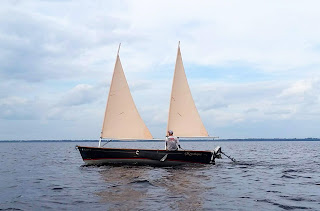
So what are those qualities that brought me back to a Sea Pearl 21?


So what are those qualities that brought me back to a Sea Pearl 21?
- Sails well solo
- Very easy to set up and take down
- Quick reefing
- Easily trailered
- Can be stored at the house
- Sails well in Florida's shallow waters and right up to beaches
- An open interior set up for camping
- Relatively inexpesinve
- Great looking boat
Friday, December 15, 2017
New Blog
I have a lot of content hosted on different sites. Facebook,
Photobucket, etc. Photobucket business model changed and may signal the
end of their hosting. Facebook is almost impossible to organize content
or search for something. So for those reasons I have decided to move
everything into one blog. Microtom is the forum handle I have used on multiple sites for a long time hence the name Journal of Microtom. The content from My Sea Pearl 21 has been loaded. I will add more over time.
Sunday, May 14, 2017
Adventure Ride in the Green Swamp
Exploring on adventure bikes with WaterTriber Bill Fite aka Jarhead around the Withlacoochee River.
Wednesday, May 3, 2017
Sunday, March 5, 2017
2017 Everglades Challenge - Check Point 1
This is the delayed start of the 2017 Everglades
Challenge. I worked as Check Point 1 Co-Captain and helped with the
delayed launch.
Friday, September 30, 2016
Chasing Bubbles
Great movie about a man who wanted to see the world by sailboat. Well worth watching.
Tuesday, April 12, 2016
2016 Ultimate Florida – Post Race Reporting
A little over a week ago I finished the WaterTribe 2016 Ultimate
Florida Challenge. It was the trip of a lifetime for someone with a
family and a corporate career. To drop everything for 30 days in
today’s fast paced society was not a trivial thing to do. I was very
fortunate to have a supportive job and wife who not only let me go but
took care of all the responsibilities that were still there while I was
chasing a personal goal.
There are a lot of things to write up and share from the trip. As I write this I think I am going to write and publish one item at a time. Possibly following an outline that will loosely create a books worth of information. My emphasis will be to help future challengers and adventurers assemble information that is helpful for them.
So with that. Here is a first post. Thank you in advance for taking the time out of your busy life to read my stuff. I hope you find it helpful and/or inspiring. I always like to hear feedback and stories about others adventures. Especially ones where you have incorporated something I might have said or written. Safe Travels!
———————————————————
The Facebook Blog……..
During the 2016 WaterTribe Ultimate Florida Challenge I posted almost daily updates on Facebook. I did this on what they call a “fan page” which means its publicly accessible and I don’t have to be Facebook friends with everyone. I found it a great way to keep trips organized and in segmented from the rest of the fast paced Facebook world. I was very impressed with how fast video uploads took on Facebook. As long as I had some mobile connectivity I could always get an update published.
To see my daily posts and get a feel of what my trip was like you can check it out here:

There are a lot of things to write up and share from the trip. As I write this I think I am going to write and publish one item at a time. Possibly following an outline that will loosely create a books worth of information. My emphasis will be to help future challengers and adventurers assemble information that is helpful for them.
So with that. Here is a first post. Thank you in advance for taking the time out of your busy life to read my stuff. I hope you find it helpful and/or inspiring. I always like to hear feedback and stories about others adventures. Especially ones where you have incorporated something I might have said or written. Safe Travels!
———————————————————
The Facebook Blog……..
During the 2016 WaterTribe Ultimate Florida Challenge I posted almost daily updates on Facebook. I did this on what they call a “fan page” which means its publicly accessible and I don’t have to be Facebook friends with everyone. I found it a great way to keep trips organized and in segmented from the rest of the fast paced Facebook world. I was very impressed with how fast video uploads took on Facebook. As long as I had some mobile connectivity I could always get an update published.
To see my daily posts and get a feel of what my trip was like you can check it out here:
Stove Kit
Part of doing a WaterTribe Challenge is making your gear organized,
efficient and as light as you feel is needed. The importance of this
varies for me but doing it some of the time keeps the total weight of my
gear down. I just happened to stumble into creating this cooking kit a
week or two before the race and it served me very well. I can’t take
credit for all of it. Some came from other adults in my son’s Boy Scout
troop. The stove came from my fishing and camping buddy Scott. I
stumbled into making it all fit together.
Here is the gear list:
– Condor H2O Pouch (No bladder or water container)
– Stanley Adventure Camp Cook Set 24oz Stainless – Steel (Only the stainless steel pot is used)
– MSR PocketRocket Stove
– Large fuel container for stove.
– A stainless steel or titanium spoon.
– An Altoids tin container
– Lighter
– Tinfoil
– Paper Towel (Wrap up stove inside pot to keep it from banging around and to use for wipe downs)
– Hot Sauce
It was very convenient to keep this kit accessible during the trip. There were occasions where I needed to cook on the go or cook without unloading the boat. For example. SandyBottom and I got stuck on a shoal when the tide went out near Highland Beach in Everglades National Park. We used that time to cook. My stove was easily accessed and we ate hot meals while we waited 3 hours for the tide to come back in. Comeing up the St. Mary’s River I needed to put in several hours of night time paddling before stopping. I stopped for 10 minutes to break out the stove and boil water. Then went back to paddling while my meal re-hydrated. An organized and quickly accessible stove kit makes
this possible.
Pictures of the kit:


 Other notes:
– I like a single piece metal spoon with a long handle. A metal spoon is easier for me to clean. I can also hold it over the flame to disinfect it if I don’t think my previous cleaning was enough. A long handle makes eating from freeze dried food back much easier.
– The “large”: fuel containers lasted almost 3 weeks during my trip. Usage was a little less than once a day due to stops at restaurants on the water from time to time.
– The MSR Pocket Rocket stove and Stanley pot is not as efficient as a
Jet Boil. It seemed to take almost twice as long to heat up water but I
still like how everything goes together and will continue to use this
kit. 3 1/2 minutes vs 7 minutes was not an issue for me.
Here is the gear list:
– Condor H2O Pouch (No bladder or water container)
– Stanley Adventure Camp Cook Set 24oz Stainless – Steel (Only the stainless steel pot is used)
– MSR PocketRocket Stove
– Large fuel container for stove.
– A stainless steel or titanium spoon.
– An Altoids tin container
– Lighter
– Tinfoil
– Paper Towel (Wrap up stove inside pot to keep it from banging around and to use for wipe downs)
– Hot Sauce
It was very convenient to keep this kit accessible during the trip. There were occasions where I needed to cook on the go or cook without unloading the boat. For example. SandyBottom and I got stuck on a shoal when the tide went out near Highland Beach in Everglades National Park. We used that time to cook. My stove was easily accessed and we ate hot meals while we waited 3 hours for the tide to come back in. Comeing up the St. Mary’s River I needed to put in several hours of night time paddling before stopping. I stopped for 10 minutes to break out the stove and boil water. Then went back to paddling while my meal re-hydrated. An organized and quickly accessible stove kit makes
this possible.
Pictures of the kit:


Measurements on the pot are very helpful

Action shot on the St. Mary’s River. Its important to note when you are
doing long distance adventure races you will start feeling tired. A lot
of times this isn’t a signal that you need sleep or rest. Its a signal
that you need fuel. Once you learn that you will be able to travel
further and faster.

– I like a single piece metal spoon with a long handle. A metal spoon is easier for me to clean. I can also hold it over the flame to disinfect it if I don’t think my previous cleaning was enough. A long handle makes eating from freeze dried food back much easier.
– The “large”: fuel containers lasted almost 3 weeks during my trip. Usage was a little less than once a day due to stops at restaurants on the water from time to time.
Sunday, July 5, 2015
New Project Boat – MX-Ray
This is not a very WaterTribe oriented updated but its small boat
sailing and its starting off with some boat repairs. Everyone can learn
something from others repair jobs so I figured I would share.
So over the summer I have somehow gone on a small boat buying spree. First it was a great deal on a recreational version of a Laser 2. When I brough it out to my local sailing club I immediately hooked up with another Laser 2 sailer and got the opportunity to upgrade to full racing version of the Laser 2. Then a week later a MX-Ray was posted on Craigslist for $200. I had been looking for an asymetrical spinnaker for the first Laser 2 for a while. There are no used ones available. Its about $800 to buy a new one from a similar sized boat which was just a little less than I had in the whole rig so I kept looking around. Thats how I found the MX-Ray. I wanted a used kite but this one had a full boat attached and it was $200. Yep, to cheap to pass up. Turns out the only thing wrong with it was a cracked mast where it joined the two sections. Not bad at all.
Here is a picture of another MX-Ray on the water for reference.

Here is the cheesy original marketing video showing how fun and fast the boat can be.
The boat has some fans who apprecite it for its speed and fun factor but gennerally serious racers are pretty harsh on the boat for its overall sailing abilities. It was the very first single handed sailboat with an asymetrical spinnaker. That was a radical concept and ahead of its time. Others soon copied and improved on the idea like the RS-100 and Musto Skiff. I am expecting it to be a challenging boat to sail and hope it performs well enough to be enjoyable so I will hold my opinion on the MX-Ray until I get it out on the water a few times.
This is my mast.


Here is the damage I am dealing with. Several splits where the two piece masts joins together. This is the base section.


My plan is to add an additional internal ferrule while repairing and extending the length of the original one. Here is a pic showing how that would work. I will make the ferrule out of carbon fiber and place it where I have the PVC.

The lower section of the mast already has additional carbon wraps where the boom attaches. I am planning to use a carbon sleeve to strengthen it where the mast is damaged.


Here is what I found that was somewhat applicable to my mast repair. Neither of them deal with fixing the joint on a two piece mast so I will be doing many things different.
These are my outstanding items.
1. Still need to come up with a plan to build the additional ferrule.
2. What is the right way to sand down the existing mast where its damaged and reinforce that section.
3. How thick can I make the lower section reinfocement without it getting to bulky.
Going to get to work soon!
So over the summer I have somehow gone on a small boat buying spree. First it was a great deal on a recreational version of a Laser 2. When I brough it out to my local sailing club I immediately hooked up with another Laser 2 sailer and got the opportunity to upgrade to full racing version of the Laser 2. Then a week later a MX-Ray was posted on Craigslist for $200. I had been looking for an asymetrical spinnaker for the first Laser 2 for a while. There are no used ones available. Its about $800 to buy a new one from a similar sized boat which was just a little less than I had in the whole rig so I kept looking around. Thats how I found the MX-Ray. I wanted a used kite but this one had a full boat attached and it was $200. Yep, to cheap to pass up. Turns out the only thing wrong with it was a cracked mast where it joined the two sections. Not bad at all.
Here is a picture of another MX-Ray on the water for reference.

The boat has some fans who apprecite it for its speed and fun factor but gennerally serious racers are pretty harsh on the boat for its overall sailing abilities. It was the very first single handed sailboat with an asymetrical spinnaker. That was a radical concept and ahead of its time. Others soon copied and improved on the idea like the RS-100 and Musto Skiff. I am expecting it to be a challenging boat to sail and hope it performs well enough to be enjoyable so I will hold my opinion on the MX-Ray until I get it out on the water a few times.
This is my mast.


Here is the damage I am dealing with. Several splits where the two piece masts joins together. This is the base section.


My plan is to add an additional internal ferrule while repairing and extending the length of the original one. Here is a pic showing how that would work. I will make the ferrule out of carbon fiber and place it where I have the PVC.

The lower section of the mast already has additional carbon wraps where the boom attaches. I am planning to use a carbon sleeve to strengthen it where the mast is damaged.


Here is what I found that was somewhat applicable to my mast repair. Neither of them deal with fixing the joint on a two piece mast so I will be doing many things different.
These are my outstanding items.
1. Still need to come up with a plan to build the additional ferrule.
2. What is the right way to sand down the existing mast where its damaged and reinforce that section.
3. How thick can I make the lower section reinfocement without it getting to bulky.
Going to get to work soon!
Monday, March 9, 2015
My Account and Assessment of the 2015 Everglades Challenge
It was an unusual weekend. I had spent most of the past year excited
for the annual cruise down the south west coast of Florida. This event
is mentally and physically demanding. It requires a lot preparation and
determination to finish. There are thousands of things along the way
that can take you out of race. Some are prior to the start like work and
family. Along the way it can be equipment failure, fatigue, injury or
even illness. But with all the preparation I never anticipated the event
being canceled by the Coast Guard and getting news that we were ordered
off the water.
2015 started like any other year. All was going smoothly for me. I had plans to paddle with Danito for as long as possible. I was able to ride with DieTired and DieTired2 to the start. We shared a camp site in Fort Desoto on Friday night. The biggest news was that the raccoons were thankfully gone and one WaterTriber was not going to make the event. He was hospitalized due to a heart issue. I went to dinner with a bunch of Tribers from Orlando and had an excellent pre-race meal. All was going according to plan.
Saturday morning roll call seemed normal. Some folks were still organizing their gear but conditions looked good. I had listened to the marine weather radio around 5 AM and they were calling for 15 – 20 and stated “small craft should exercise caution” which I took to mean that the potential for rough water was likely but there was no small craft warning in effect. Basically for me and my canoe I would have to proceed cautiously.
When I got to the starting beach the tide was very low. Most likely the result of the wind creating a stronger than usual tide. Since the launch was on the leeward side the water looked calm near shore but when I looked at a powerboat way off shore heading west on plane it was clear that there was a good chop on the water.
The first half of the bay crossing was fairly uneventful. Danito and I were paddling within 100 yards of each other. As we got further across the conditions continued to build. We were running 1 meter Flat Earth Kayak Sails or FEKS. I was mostly sailing. I would occasionally paddle and brace a bit in the bigger gusts. The wind gusts were strong enough to be causing my deck to flex under the load. When I saw that I eased the sail out and bled off some of the speed and power. Most of the time I was consistently making 4.5 – 5.5 knots which is moving quite well. Its about then that I grabbed my phone and took my first video.
It was soon after this that I happened upon the first capsize assistance being performed. I didn’t know the guy who had rolled. There was already a veteran Triber lending assistance. I acted as the 2nd assist by collecting his paddle and float nearby and then pulling up along side the 1st responder. We were able to get the guy situated and then proceeded on our way.

It took me by surprise when I looked to my right and saw another Triber was in the water and already getting assistance. It was SandyBottom being assisted by FeralCat. As I approached she skillfully got back into her boat and with one of us on each side of her we proceeded to pump her boat out with two hand bilge pumps. This one caught me off guard because the person who went over was one of the most experienced and skilled kayakers that I know. I am looking forward to reading her account of what happened but my speculation is that it was a combination of the conditions, a high performance narrow kayak, and very large expedition load.
Updated: Her account is now here:
http://watertribe.org/forums/topic/sandybottom-ec-2015-report
Conditions were getting worse as we got further across the bay. I had anticipated this. My plan was to head east of my intended crossing point so that first and foremost I wouldn’t miss the ICW on the other side. Second, as the conditions worsened I would be able to turn so that I would have following seas instead of waves hitting me on the beam. That plan pretty much fell apart the second time I gave assistance because were standing still in the water long enough to drift west of my intended line.
How bad were the conditions out there? I really don’t think they were bad at all. Don’t get me wrong it was very windy and the seas were up but not anything that I would call storm conditions. It should have been manageable for anyone who was an expert in their small boat of choice and in good physical condition. Those that I saw roll and performed a wet exit did great jobs recovering. I am confident they would have been fine on their own too. The assistance we provided was just that, assistance, not a rescue. The others that I heard about after the race were different cases. An I550 sailboat capsized near Anna Maria Island and one account that I heard from a person with 1st hand knowledge of that boat was they hadn’t taken appropriate caution which resulted in the boat going over. I spoke with the person who radioed it in. He was on channel 16 requesting a commercial tow for them because there wasn’t an emergency and everyone was ok but the Coast Guard responded anyways.
OneEyedJake also gave assistance to Tribers in need that resulted in the coast guard being called. He recounted the story on FaceBook and its worth sharing.
“The morning started out with a rather bleak weather forecast. Wind on the high side at 20-ish with higher gusts. A little stronger later on. Out of the north east. With an incoming tide. What that means is that two really strong forces of nature are directly opposed to each other. Wind out of the northeast down the 35 mile length of Tampa Bay pushing against the Gulf of Mexico pushing it’s way in on an incoming tide and meeting at the mouth of Tampa Bay can provide some interesting conditions pushing up big waves and strong opposing currents.
Pretty much smack dab in the middle of the 7 mile open water crossing of Tampa Bay, Mary and I watched as a tandem kayak capsized with two guys aboard. We immediately headed over to help.
They were having no luck trying to right the big (20ft or so) kayak and climb in. We could tell that the cold water was taking it’s toll on them. Mary swooped in to give them some direction after seeing that they were unsuccessful on their own. I circled the boat retrieving items floating away.
They managed to dump some of the water and climb aboard. Almost immediately the entire front of the kayak and front cockpit went underwater and began to sink. Both paddlers exited quickly. Mary and I got our hand pumps and began to help the guys pump out.
That was initially unsuccessful. We would get a little water out and a wave would wash over us filling the cockpit completely. By this time one of the paddlers is showing signs of hypothermia.
Between Mary and I pumping we managed to empty the front cockpit of enough water that the boat would float and got the first paddler aboard. We moved to the rear cockpit and worked on pumping that out too and getting the second paddler aboard.
As they began paddling we realized that we would have to follow them to shore. Both were tired, very cold and paddling slowly in rough conditions.
We watched dejectedly as the bow of the big tandem slowly settled into the water. Every wave seem to be crashing over the paddlers and adding more water to the cockpits. The spray skirts they had were not up to the job.
As expected, the boat rolled over and the paddlers were swimming in the cold, rough water again about a mile off shore. More gear scattered as we closed in. Attempts to clear water out were futile. The cold and exhausted paddlers were not able to assist. One guy in the water was holding onto my kayak and his legs were shaking so much he sounded a woodpecker against the hull. I made a call to the Coast Guard on the VHF radio.
At the same time we were enjoying our time on the water, in the distance we could see at least two other rescues happening. Two kayaks headed our way, we thought to help, but had to keep on going to shore. One had water in a rear compartment and was in danger of sinking (JammerJim). TideRider was assisting him to land.
Shortly after that, SwampGator and OysterSlayer went by headed for shore. As the Coast Guard arrived we broke off and rafted up with these guys to help get OysterSlayer to shore safely. OysterSlayer had taken enough water aboard to make his kayak unstable in the rough water.
We approached Anna Maria Island about a mile away and entered Bimini Bay,a protected cove. While sorting out the situation, sharing experiences and fixing the kayaks we heard on the VHF that the Coast Guard had declared the end of the race and told all participants to head to shore. They had had to rescue 11 participants and were overwhelmed.
We felt bad for the guys who had such a rough time on the bay. At the same time we were exhilarated that our training and experience helped to salvage a bad situation, at least for awhile.
A great learning experience also. Many mistakes were made and while camping that night we re-hashed the day and tried to figure what we could have done better. I’m sure glad it wasn’t one of us that needed rescuing.“
Pictures from Tampa Bay
As we finished our crossing of the bay the water became shallow while
passing over a sand bar. I turned so that the waves were directly
behind me and started to catch a few. This was fun! I was able to surf
my fully loaded Kruger Dreamcatcher for several seconds. When I looked
down at the GPS it was reading over 10 knots! Next we saw the Coast
Guard come screaming by with lights blazing. I gave them the thumbs up
and knew there was likely trouble for someone out there but I never
suspected that it was going to be several boats. It just didn’t look
that bad out there.
Inside the Intra Coastal Waterway we proceeded to have a relaxed paddle. We passed under the first bridge and I shot video #2
Our next concern was Sarasota Bay. Danito had been there before and after seeing Tampa Bay give some people trouble I followed his suggestion to stay east in lee of Sisters Key. This worked great and as we got to the center of the bay it was calm enough to take off my foul weather gear and spray skirt.
We travelled like this for quite some time before coming to a bridge north of Venice where a Triber volunteering in the race was giving verbal updates. He was a little far away but we got the message that there had been significant trouble. He said that we were to notify our shore contacts that we were ok and proceed to our safest take out point. I yelled back that we were going to CP1. I made that decision because the rest of the trip was in the protected ICW and that was my float plan.
Once this all went down I turned my phone back on. I had a text message and voice mail from my wife who was my shore contact stating we were ordered to get off the water. I pulled up the WaterTribe forum where I found posts from Chief and PaddleDancer stating that the race was cancelled at check point 1 in Cape Haze Marina. That was 25 miles away but for a Triber that just an afternoon or evening sail/paddle so no big deal.
Dannito and I discussed our options long the way with Scareman. We were concerned for the people who were rescued but boggled by the cancellation. There was a lot of discussion about going on anyways but we also talked about getting the full story at CP1 before making a decision.
The evening paddle was amazing. Winds were only a bit helpful. Mostly we were paddling. I was able to get one neat photo of Danito at night.

Once we arrived at CP1 we saw a lot of boats but not everyone. Some who arrived had already left. There were several reason shared by 3rd parties so take them with a grain of salt. I heard that some were going to go rouge, some were out of the event but proceed as a vacation trip, some had their car, trailer and family in the keys so they had to get there anyways, some were organizing their own catamaran group sail. I was surprised that Chief and PaddleDancer were not there answering questions. Instead the check point volunteer was was trying to handle things as best he could but he didn’t have official updates to share. He really was doing the best he could under the circumstances.
I spoke with FeralCat. For me he was the voice of reason in the group. After hearing his calm and rational assessment I came to either the same or very close assessment that having Tribers on the water and heading in the same direction as the original course would be construed by the Coast Guard as proceeding and disregarding their clear directions. If someone was to have another emergency after proceeding it would only make the current situation worse. For that reason I choose do as the Coast Guard directed and take out at CP1.
So that was it for me. I made camp at CP1. Sunday morning I had to get my boat out of the water so paddled down to Placida boat ramp 5 miles to the south and waited to be picked up by DieTired and crew. We shuttled two more Tribers back to Tampa to get their cars and then went home.
Assessing Events
Since we had a long drive there was plenty of time to read forum posts, news accounts, and Facebook. When reading these there were a few things that stood out and I am going to try and share my thoughts.
Looking for more information I went to Sailing Anarchy. This is an independent sailing news site that prides itself on a no BS and no holds barred approach to covering the sport’s news. So if you are looking for constructive criticism and have thick skin this is a good place get it. The article is here.
http://sailinganarchy.com/2015/03/08/terminated/
The link to the forum is a must read. It contains posts from many WaterTribers but you will have to navigate the normal Internet stupidity to see the quality content. (One Note: Mr. Clean is the Sailing Anarchy owner/operator/main writer. He does give tough but constructive feedback.)
How Many?
I also found the link to these articles that stated 11 or 12 people were “rescued” by the Coast Guard :
http://www.nbc-2.com/story/28287612/coast-guard-terminates-water-tribe-challenge
http://www.uscgnews.com/go/doc/4007/2475042
Ok, Lets pause for a second and look at it with a critical eye. I have a first responder on the water background. I have performed many rescues and provided assistance to many more. As soon as I see a large total for rescues I don’t implicitly believe the stats. The Coast Guard deserves our respect for the job they do but we should be careful when we read these reports. They are capable of tooting their own horn a bit too much. They are human just like the rest of us. Remember the above report that a call was made for a commercial tow and Coast Guard showed up? I hope that WaterTribe organizers with the assistance of elders (term for multiple finishers) and participants will document a comprehensive time line of events that occurred in Tampa Bay so we can sort out who really got rescued and who were both assisted by other Tribers and the Coast Guard. In my opinion this has to happen prior to any recommendations for corrective actions being made.
Marine Event Permits
It was after reading the Sailing Anarchy post that 1st learned that a MEP was required. It makes sense but frankly I didn’t know that prior to the event. I have a lot of on the water event experience, especially in small boats, and this has never come up in the past. I would imagine that all of the events I have participated in the past never had one.
– Weekly Sailboat Rum Races
– Small Sailboat Regattas put on by Yacht Clubs
– Boat Rallies
– Fishing Tournaments
– Group Campouts on Islands
– Open Water Swims
– Canoe/Kayak Races
I wondered if Chief knew about it because I didn’t.
This requirement conflicts with the original intent which was to have an unsupported expedition style event that condensed a longer trip into a week. My speculation is that the WaterTribe and Everglades challenge started with a manageable sized group participating. Everyone is suppose to be highly skilled experts and very well prepared for all conditions. The Internet and media coverage of this event along with the relatively low cost (compared to big boats) has drawn more and more participants. I like to refer to it as being a victim of your own success. With over 100 boats launching at the same time and immediately crossing a large body of water it makes sense that WaterTribe get the MEP as required by the Coast Guard.
One concern that I have heard is that will place additional costs on event organizers and participants. My hope is that this will be relatively small. My suggestions is that going forward organizers require participants to have a Boat US membership that is tied to their Spot Messenger.
http://findmespot.com/en/index.php?cid=115
Depending upon how its negotiated with Boat US and Spot we may be able to demonstrate that we are registering 100+ new users every year which based on a complete guess of $60 year for basic service that would be $6000 total. If we were to require the premium service for the captain of each vessel at $170 a year it would be $17000 a year for Boat US. That may be enough incentive to have them station multiple boats in Tampa Bay on the day of the start and one on call for Charlotte Harbor Saturday and Sunday. Just thinking out loud here. It will take some time to figure out what is a good idea and what is feasible.
Safety Checks and Experience Levels
S#!% happens from time to time and even the most prepared get in trouble but the volume of assists and rescues that occurred this year requires re-evaluating protocols. I have a lot of random thoughts on this that may be worth considering.
How do we do a better job evaluating first time participants? Watertribe already has one of the best safety gear requirements list out there. There is a proven focus on safety in all situations. This equipment list is checked by a veteran Triber before the race begins. Its a good system but clearly its not stopping everyone who may not be fully prepared from setting off.
Should the check off be stricter? Do we exclude people based on this evaluation.
Should we have a pre-race certification process? With entrants coming from all over how?
Should we make boats in Class 1 and 2 go off the beach fully loaded on Friday before the event and purposely flip the boat with all their gear to prove they can re-enter safely?
Should all classes have to prove they have had their boat rigged and tested several months before the race starts?
Should all classes have to demonstrate that the boat in its current rigged state has participated in at least one long event prior to entering the Everglades Challenge?
Should a buddy system be in place for all rookies in the race? At least for crossing Tampa Bay when a small craft warning is in effect?
The Stupid Tax
Before getting started I would like to say that Steve Isaac aka Chief needs to be recognized for doing many things right before he is criticized for not having a MEP. I have nothing but respect for his leadership and attention to safety. I know of no other person that does as good of a job as Chief in emphasizing safety, educating and preparing those who wish to participate in our events. If there was a mistake on his part then he will correct it going forward. This an opportunity. WaterTribe will improve and grow from it.
The following is a reply to OneEyedJake’s Facebook post:
Len Perry “Great recap of events. Too bad sponsor of the EC2015 did not apply for a sanctioned Marine Permit. I believe that had the required permits for this type of event been submitted to the USCG, including having event sponsored safety vessels in the area, the outcome would have been different. The USCG may have only suspended -or placed on hold – the EC for a specific time to ensure that all event participants were safe and accounted for, and then allow the EC to proceed. I know from experience with Offshore Powerboat World Racing events when I was the Operations Officer stationed with the USCG in Key West, that it would not be unusual for the USCG to place a hold or suspended for a time period an event due to sea conditions or problems with race participants (i,e, sinking of race boat with loss of life). Had the EC2015 sponsor applied for a Maritime Event permit, all parties involved, i.e. USCG and event sponsor, would meet to discuss how many safety vessels would be required, in addition to an on scene USCG Command and Control vessel, and a predetermined number of USCG boats that would be needed to cover the events safety zone. With all that being said, I would not be surprised if the USCG issues a fine to the sponsor of the event, and not allow another EC to occur unless permits are submitted. The USCG is going to take the stance that the event sponsor not only risked the lives of the EC participants by not having prior approval, the sponsor also risked the lives of the USCG small boat crews along with the USCG flight crew members who had to respond from CG Air Station Clearwater. Additionally, the EC sponsor can be fined a dollar amount to recover the expense of the CG units that were involved with the rescues. Most people would now be asking – what do I pay taxes for? The answer is simple – to have the USCG on call for when an unexpected emergency occurs. However, the EC sponsors acknowledge prior to the event to all participants that hazards/emergencies may be encounter by participants, and requires specific safety equipment for all participants. Yet the EC sponsor does not provide any safety vessels, and believes that by having the participants sign a waiver of liability relieves the EC sponsor of any liability. This is not true, event sponsor can be found responsible and culpable in that the EC sponsor anticipated the possibility of emergencies arising during the event. Therefore, I would anticipate a move by the USCG to fine the EC2015 event sponsor. Fines in this case could be in the amount of $5,000. per incident/participant. Of course a hearing would be held and the fines could be mitigated – but that in itself would be expensive. It would not be unusual to see a fine after mitigation in the amount of $50,000 or higher.”
While I am appreciative of the information I am appalled at the idea that fines could be levied against WaterTribe. This event is structured with safety being a priority. While there may have not been a MEP in place, WaterTribe is a group that has consistently promoted and enforced safety on the water. It would be a real tragedy if organizers were monetarily penalized (a tax for being stupid) because of unprepared participants, poor judgement by participants, and even prepared participants who were did have a real emergency outside of their control. Yes corrective actions need to be done. I would support the following:
– Require a MEP going forward
– Have WaterTribe work with the Coast Guard to do PSAs on MEP requirements going forward.
But again no stupid tax. Fines are not going to help anyone. It only hurts a group that has a history of being focused on safety.
Reference Information on Marine Event Permits
Coast Guard Statute
http://www.ecfr.gov/cgi-bin/text-idx?SID=30fe9ca7259f714f97fe062547ca55cd&node=pt33.1.100&rgn=div5
MEP Overview
http://www.uscg.mil/hq/cg6/cg611/COI/omb/1625-0008.pdf
MEP Online Form
https://homeport.uscg.mil/mycg/portal/ep/marine_event/marine_event_form.jsp
2015 started like any other year. All was going smoothly for me. I had plans to paddle with Danito for as long as possible. I was able to ride with DieTired and DieTired2 to the start. We shared a camp site in Fort Desoto on Friday night. The biggest news was that the raccoons were thankfully gone and one WaterTriber was not going to make the event. He was hospitalized due to a heart issue. I went to dinner with a bunch of Tribers from Orlando and had an excellent pre-race meal. All was going according to plan.
Saturday morning roll call seemed normal. Some folks were still organizing their gear but conditions looked good. I had listened to the marine weather radio around 5 AM and they were calling for 15 – 20 and stated “small craft should exercise caution” which I took to mean that the potential for rough water was likely but there was no small craft warning in effect. Basically for me and my canoe I would have to proceed cautiously.
When I got to the starting beach the tide was very low. Most likely the result of the wind creating a stronger than usual tide. Since the launch was on the leeward side the water looked calm near shore but when I looked at a powerboat way off shore heading west on plane it was clear that there was a good chop on the water.
Quadcopter video from a spectator confirms conditions looked
almost too good at the launch. It was a different story further off
shore.
The first half of the bay crossing was fairly uneventful. Danito and I were paddling within 100 yards of each other. As we got further across the conditions continued to build. We were running 1 meter Flat Earth Kayak Sails or FEKS. I was mostly sailing. I would occasionally paddle and brace a bit in the bigger gusts. The wind gusts were strong enough to be causing my deck to flex under the load. When I saw that I eased the sail out and bled off some of the speed and power. Most of the time I was consistently making 4.5 – 5.5 knots which is moving quite well. Its about then that I grabbed my phone and took my first video.
It was soon after this that I happened upon the first capsize assistance being performed. I didn’t know the guy who had rolled. There was already a veteran Triber lending assistance. I acted as the 2nd assist by collecting his paddle and float nearby and then pulling up along side the 1st responder. We were able to get the guy situated and then proceeded on our way.

Green kayak being assisted after wet exit and re-entry. (Blurriness is from water on the lens)
It took me by surprise when I looked to my right and saw another Triber was in the water and already getting assistance. It was SandyBottom being assisted by FeralCat. As I approached she skillfully got back into her boat and with one of us on each side of her we proceeded to pump her boat out with two hand bilge pumps. This one caught me off guard because the person who went over was one of the most experienced and skilled kayakers that I know. I am looking forward to reading her account of what happened but my speculation is that it was a combination of the conditions, a high performance narrow kayak, and very large expedition load.
Updated: Her account is now here:
http://watertribe.org/forums/topic/sandybottom-ec-2015-report
Conditions were getting worse as we got further across the bay. I had anticipated this. My plan was to head east of my intended crossing point so that first and foremost I wouldn’t miss the ICW on the other side. Second, as the conditions worsened I would be able to turn so that I would have following seas instead of waves hitting me on the beam. That plan pretty much fell apart the second time I gave assistance because were standing still in the water long enough to drift west of my intended line.
How bad were the conditions out there? I really don’t think they were bad at all. Don’t get me wrong it was very windy and the seas were up but not anything that I would call storm conditions. It should have been manageable for anyone who was an expert in their small boat of choice and in good physical condition. Those that I saw roll and performed a wet exit did great jobs recovering. I am confident they would have been fine on their own too. The assistance we provided was just that, assistance, not a rescue. The others that I heard about after the race were different cases. An I550 sailboat capsized near Anna Maria Island and one account that I heard from a person with 1st hand knowledge of that boat was they hadn’t taken appropriate caution which resulted in the boat going over. I spoke with the person who radioed it in. He was on channel 16 requesting a commercial tow for them because there wasn’t an emergency and everyone was ok but the Coast Guard responded anyways.
OneEyedJake also gave assistance to Tribers in need that resulted in the coast guard being called. He recounted the story on FaceBook and its worth sharing.
“The morning started out with a rather bleak weather forecast. Wind on the high side at 20-ish with higher gusts. A little stronger later on. Out of the north east. With an incoming tide. What that means is that two really strong forces of nature are directly opposed to each other. Wind out of the northeast down the 35 mile length of Tampa Bay pushing against the Gulf of Mexico pushing it’s way in on an incoming tide and meeting at the mouth of Tampa Bay can provide some interesting conditions pushing up big waves and strong opposing currents.
Pretty much smack dab in the middle of the 7 mile open water crossing of Tampa Bay, Mary and I watched as a tandem kayak capsized with two guys aboard. We immediately headed over to help.
They were having no luck trying to right the big (20ft or so) kayak and climb in. We could tell that the cold water was taking it’s toll on them. Mary swooped in to give them some direction after seeing that they were unsuccessful on their own. I circled the boat retrieving items floating away.
They managed to dump some of the water and climb aboard. Almost immediately the entire front of the kayak and front cockpit went underwater and began to sink. Both paddlers exited quickly. Mary and I got our hand pumps and began to help the guys pump out.
That was initially unsuccessful. We would get a little water out and a wave would wash over us filling the cockpit completely. By this time one of the paddlers is showing signs of hypothermia.
Between Mary and I pumping we managed to empty the front cockpit of enough water that the boat would float and got the first paddler aboard. We moved to the rear cockpit and worked on pumping that out too and getting the second paddler aboard.
As they began paddling we realized that we would have to follow them to shore. Both were tired, very cold and paddling slowly in rough conditions.
We watched dejectedly as the bow of the big tandem slowly settled into the water. Every wave seem to be crashing over the paddlers and adding more water to the cockpits. The spray skirts they had were not up to the job.
As expected, the boat rolled over and the paddlers were swimming in the cold, rough water again about a mile off shore. More gear scattered as we closed in. Attempts to clear water out were futile. The cold and exhausted paddlers were not able to assist. One guy in the water was holding onto my kayak and his legs were shaking so much he sounded a woodpecker against the hull. I made a call to the Coast Guard on the VHF radio.
At the same time we were enjoying our time on the water, in the distance we could see at least two other rescues happening. Two kayaks headed our way, we thought to help, but had to keep on going to shore. One had water in a rear compartment and was in danger of sinking (JammerJim). TideRider was assisting him to land.
Shortly after that, SwampGator and OysterSlayer went by headed for shore. As the Coast Guard arrived we broke off and rafted up with these guys to help get OysterSlayer to shore safely. OysterSlayer had taken enough water aboard to make his kayak unstable in the rough water.
We approached Anna Maria Island about a mile away and entered Bimini Bay,a protected cove. While sorting out the situation, sharing experiences and fixing the kayaks we heard on the VHF that the Coast Guard had declared the end of the race and told all participants to head to shore. They had had to rescue 11 participants and were overwhelmed.
We felt bad for the guys who had such a rough time on the bay. At the same time we were exhilarated that our training and experience helped to salvage a bad situation, at least for awhile.
A great learning experience also. Many mistakes were made and while camping that night we re-hashed the day and tried to figure what we could have done better. I’m sure glad it wasn’t one of us that needed rescuing.“
Pictures from Tampa Bay
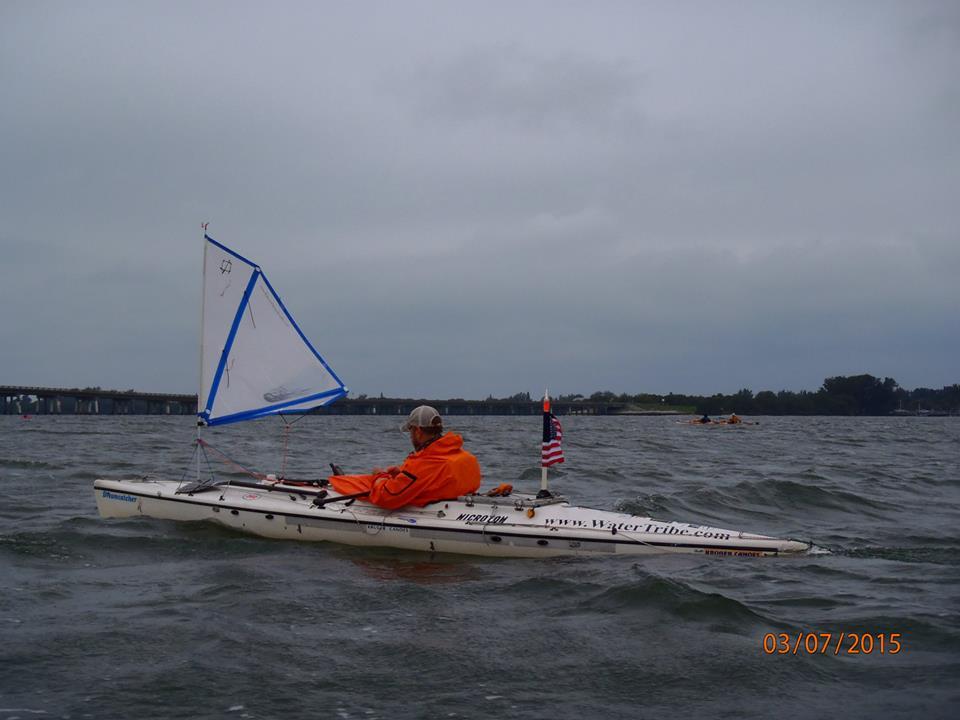 |
| Picture of me taken by Danito |
 |
| Danito very comfortable in a Kruger Canoe outfitted with a one meter Flat Earth Kayak Sail or FEKS. |
 |
| SandyBottom enjoying her paddle. |

 |
| Feralcat cruising. Very impressed with the way he handled himself on and off the water. |
Inside the Intra Coastal Waterway we proceeded to have a relaxed paddle. We passed under the first bridge and I shot video #2
Our next concern was Sarasota Bay. Danito had been there before and after seeing Tampa Bay give some people trouble I followed his suggestion to stay east in lee of Sisters Key. This worked great and as we got to the center of the bay it was calm enough to take off my foul weather gear and spray skirt.
We travelled like this for quite some time before coming to a bridge north of Venice where a Triber volunteering in the race was giving verbal updates. He was a little far away but we got the message that there had been significant trouble. He said that we were to notify our shore contacts that we were ok and proceed to our safest take out point. I yelled back that we were going to CP1. I made that decision because the rest of the trip was in the protected ICW and that was my float plan.
Once this all went down I turned my phone back on. I had a text message and voice mail from my wife who was my shore contact stating we were ordered to get off the water. I pulled up the WaterTribe forum where I found posts from Chief and PaddleDancer stating that the race was cancelled at check point 1 in Cape Haze Marina. That was 25 miles away but for a Triber that just an afternoon or evening sail/paddle so no big deal.
Dannito and I discussed our options long the way with Scareman. We were concerned for the people who were rescued but boggled by the cancellation. There was a lot of discussion about going on anyways but we also talked about getting the full story at CP1 before making a decision.
The evening paddle was amazing. Winds were only a bit helpful. Mostly we were paddling. I was able to get one neat photo of Danito at night.

Once we arrived at CP1 we saw a lot of boats but not everyone. Some who arrived had already left. There were several reason shared by 3rd parties so take them with a grain of salt. I heard that some were going to go rouge, some were out of the event but proceed as a vacation trip, some had their car, trailer and family in the keys so they had to get there anyways, some were organizing their own catamaran group sail. I was surprised that Chief and PaddleDancer were not there answering questions. Instead the check point volunteer was was trying to handle things as best he could but he didn’t have official updates to share. He really was doing the best he could under the circumstances.
I spoke with FeralCat. For me he was the voice of reason in the group. After hearing his calm and rational assessment I came to either the same or very close assessment that having Tribers on the water and heading in the same direction as the original course would be construed by the Coast Guard as proceeding and disregarding their clear directions. If someone was to have another emergency after proceeding it would only make the current situation worse. For that reason I choose do as the Coast Guard directed and take out at CP1.
So that was it for me. I made camp at CP1. Sunday morning I had to get my boat out of the water so paddled down to Placida boat ramp 5 miles to the south and waited to be picked up by DieTired and crew. We shuttled two more Tribers back to Tampa to get their cars and then went home.
Assessing Events
Since we had a long drive there was plenty of time to read forum posts, news accounts, and Facebook. When reading these there were a few things that stood out and I am going to try and share my thoughts.
Looking for more information I went to Sailing Anarchy. This is an independent sailing news site that prides itself on a no BS and no holds barred approach to covering the sport’s news. So if you are looking for constructive criticism and have thick skin this is a good place get it. The article is here.
http://sailinganarchy.com/2015/03/08/terminated/
The link to the forum is a must read. It contains posts from many WaterTribers but you will have to navigate the normal Internet stupidity to see the quality content. (One Note: Mr. Clean is the Sailing Anarchy owner/operator/main writer. He does give tough but constructive feedback.)
How Many?
I also found the link to these articles that stated 11 or 12 people were “rescued” by the Coast Guard :
http://www.nbc-2.com/story/28287612/coast-guard-terminates-water-tribe-challenge
http://www.uscgnews.com/go/doc/4007/2475042
Ok, Lets pause for a second and look at it with a critical eye. I have a first responder on the water background. I have performed many rescues and provided assistance to many more. As soon as I see a large total for rescues I don’t implicitly believe the stats. The Coast Guard deserves our respect for the job they do but we should be careful when we read these reports. They are capable of tooting their own horn a bit too much. They are human just like the rest of us. Remember the above report that a call was made for a commercial tow and Coast Guard showed up? I hope that WaterTribe organizers with the assistance of elders (term for multiple finishers) and participants will document a comprehensive time line of events that occurred in Tampa Bay so we can sort out who really got rescued and who were both assisted by other Tribers and the Coast Guard. In my opinion this has to happen prior to any recommendations for corrective actions being made.
Marine Event Permits
It was after reading the Sailing Anarchy post that 1st learned that a MEP was required. It makes sense but frankly I didn’t know that prior to the event. I have a lot of on the water event experience, especially in small boats, and this has never come up in the past. I would imagine that all of the events I have participated in the past never had one.
– Weekly Sailboat Rum Races
– Small Sailboat Regattas put on by Yacht Clubs
– Boat Rallies
– Fishing Tournaments
– Group Campouts on Islands
– Open Water Swims
– Canoe/Kayak Races
I wondered if Chief knew about it because I didn’t.
This requirement conflicts with the original intent which was to have an unsupported expedition style event that condensed a longer trip into a week. My speculation is that the WaterTribe and Everglades challenge started with a manageable sized group participating. Everyone is suppose to be highly skilled experts and very well prepared for all conditions. The Internet and media coverage of this event along with the relatively low cost (compared to big boats) has drawn more and more participants. I like to refer to it as being a victim of your own success. With over 100 boats launching at the same time and immediately crossing a large body of water it makes sense that WaterTribe get the MEP as required by the Coast Guard.
One concern that I have heard is that will place additional costs on event organizers and participants. My hope is that this will be relatively small. My suggestions is that going forward organizers require participants to have a Boat US membership that is tied to their Spot Messenger.
http://findmespot.com/en/index.php?cid=115
Depending upon how its negotiated with Boat US and Spot we may be able to demonstrate that we are registering 100+ new users every year which based on a complete guess of $60 year for basic service that would be $6000 total. If we were to require the premium service for the captain of each vessel at $170 a year it would be $17000 a year for Boat US. That may be enough incentive to have them station multiple boats in Tampa Bay on the day of the start and one on call for Charlotte Harbor Saturday and Sunday. Just thinking out loud here. It will take some time to figure out what is a good idea and what is feasible.
Safety Checks and Experience Levels
S#!% happens from time to time and even the most prepared get in trouble but the volume of assists and rescues that occurred this year requires re-evaluating protocols. I have a lot of random thoughts on this that may be worth considering.
How do we do a better job evaluating first time participants? Watertribe already has one of the best safety gear requirements list out there. There is a proven focus on safety in all situations. This equipment list is checked by a veteran Triber before the race begins. Its a good system but clearly its not stopping everyone who may not be fully prepared from setting off.
Should the check off be stricter? Do we exclude people based on this evaluation.
Should we have a pre-race certification process? With entrants coming from all over how?
Should we make boats in Class 1 and 2 go off the beach fully loaded on Friday before the event and purposely flip the boat with all their gear to prove they can re-enter safely?
Should all classes have to prove they have had their boat rigged and tested several months before the race starts?
Should all classes have to demonstrate that the boat in its current rigged state has participated in at least one long event prior to entering the Everglades Challenge?
Should a buddy system be in place for all rookies in the race? At least for crossing Tampa Bay when a small craft warning is in effect?
The Stupid Tax
Before getting started I would like to say that Steve Isaac aka Chief needs to be recognized for doing many things right before he is criticized for not having a MEP. I have nothing but respect for his leadership and attention to safety. I know of no other person that does as good of a job as Chief in emphasizing safety, educating and preparing those who wish to participate in our events. If there was a mistake on his part then he will correct it going forward. This an opportunity. WaterTribe will improve and grow from it.
The following is a reply to OneEyedJake’s Facebook post:
Len Perry “Great recap of events. Too bad sponsor of the EC2015 did not apply for a sanctioned Marine Permit. I believe that had the required permits for this type of event been submitted to the USCG, including having event sponsored safety vessels in the area, the outcome would have been different. The USCG may have only suspended -or placed on hold – the EC for a specific time to ensure that all event participants were safe and accounted for, and then allow the EC to proceed. I know from experience with Offshore Powerboat World Racing events when I was the Operations Officer stationed with the USCG in Key West, that it would not be unusual for the USCG to place a hold or suspended for a time period an event due to sea conditions or problems with race participants (i,e, sinking of race boat with loss of life). Had the EC2015 sponsor applied for a Maritime Event permit, all parties involved, i.e. USCG and event sponsor, would meet to discuss how many safety vessels would be required, in addition to an on scene USCG Command and Control vessel, and a predetermined number of USCG boats that would be needed to cover the events safety zone. With all that being said, I would not be surprised if the USCG issues a fine to the sponsor of the event, and not allow another EC to occur unless permits are submitted. The USCG is going to take the stance that the event sponsor not only risked the lives of the EC participants by not having prior approval, the sponsor also risked the lives of the USCG small boat crews along with the USCG flight crew members who had to respond from CG Air Station Clearwater. Additionally, the EC sponsor can be fined a dollar amount to recover the expense of the CG units that were involved with the rescues. Most people would now be asking – what do I pay taxes for? The answer is simple – to have the USCG on call for when an unexpected emergency occurs. However, the EC sponsors acknowledge prior to the event to all participants that hazards/emergencies may be encounter by participants, and requires specific safety equipment for all participants. Yet the EC sponsor does not provide any safety vessels, and believes that by having the participants sign a waiver of liability relieves the EC sponsor of any liability. This is not true, event sponsor can be found responsible and culpable in that the EC sponsor anticipated the possibility of emergencies arising during the event. Therefore, I would anticipate a move by the USCG to fine the EC2015 event sponsor. Fines in this case could be in the amount of $5,000. per incident/participant. Of course a hearing would be held and the fines could be mitigated – but that in itself would be expensive. It would not be unusual to see a fine after mitigation in the amount of $50,000 or higher.”
While I am appreciative of the information I am appalled at the idea that fines could be levied against WaterTribe. This event is structured with safety being a priority. While there may have not been a MEP in place, WaterTribe is a group that has consistently promoted and enforced safety on the water. It would be a real tragedy if organizers were monetarily penalized (a tax for being stupid) because of unprepared participants, poor judgement by participants, and even prepared participants who were did have a real emergency outside of their control. Yes corrective actions need to be done. I would support the following:
– Require a MEP going forward
– Have WaterTribe work with the Coast Guard to do PSAs on MEP requirements going forward.
But again no stupid tax. Fines are not going to help anyone. It only hurts a group that has a history of being focused on safety.
Reference Information on Marine Event Permits
Coast Guard Statute
http://www.ecfr.gov/cgi-bin/text-idx?SID=30fe9ca7259f714f97fe062547ca55cd&node=pt33.1.100&rgn=div5
MEP Overview
http://www.uscg.mil/hq/cg6/cg611/COI/omb/1625-0008.pdf
MEP Online Form
https://homeport.uscg.mil/mycg/portal/ep/marine_event/marine_event_form.jsp
Subscribe to:
Posts (Atom)
Weekend Expeditions: Connections Across Maine
More of why we paddle. https://www.youtube.com/watch?v=sWFSZR4uZ0w

-
 My new Savage River Falcon ready for its maiden voyage. Sometime last year I started talking with John Diller, owner of Savage River. T...
 -
 Great article originally posted on seapearlboats.org and recovered using archive.org How to go Cruising in Comfort in a Small Boat By Ron...
 -
 First off, thanks to my friend Jason for showing up and helping out. Great having you on the boat. If your willing to crew again I will su...