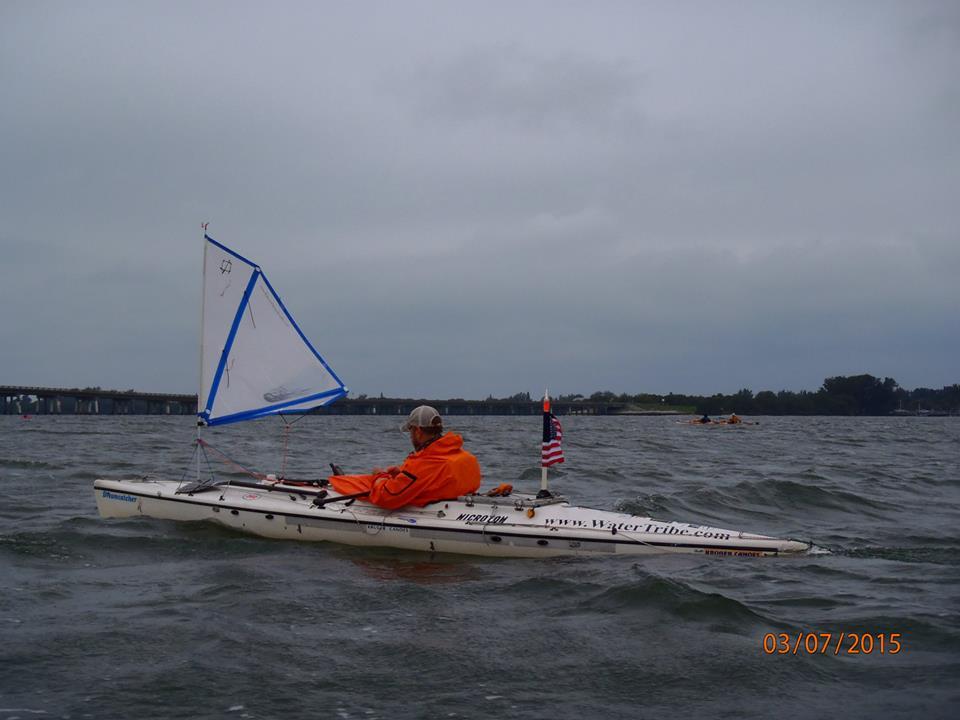
This is not a very WaterTribe oriented updated but its small boat
sailing and its starting off with some boat repairs. Everyone can learn
something from others repair jobs so I figured I would share.
So over the summer I have somehow gone on a small boat buying spree.
First it was a great deal on a recreational version of a Laser 2. When I
brough it out to my local sailing club I immediately hooked up with
another Laser 2 sailer and got the opportunity to upgrade to full racing
version of the Laser 2. Then a week later a MX-Ray was posted on
Craigslist for $200. I had been looking for an asymetrical spinnaker for
the first Laser 2 for a while. There are no used ones available. Its
about $800 to buy a new one from a similar sized boat which was just a
little less than I had in the whole rig so I kept looking around. Thats
how I found the MX-Ray. I wanted a used kite but this one had a full
boat attached and it was $200. Yep, to cheap to pass up. Turns out the
only thing wrong with it was a cracked mast where it joined the two
sections. Not bad at all.
Here is a picture of another MX-Ray on the water for reference.
Here is the cheesy original marketing video showing how fun and fast the boat can be.
The boat has some fans who apprecite it for its speed and fun factor
but gennerally serious racers are pretty harsh on the boat for its
overall sailing abilities. It was the very first single handed sailboat
with an asymetrical spinnaker. That was a radical concept and ahead of
its time. Others soon copied and improved on the idea like the RS-100
and Musto Skiff. I am expecting it to be a challenging boat to sail and
hope it performs well enough to be enjoyable so I will hold my opinion
on the MX-Ray until I get it out on the water a few times.
This is my mast.
Here is the damage I am dealing with. Several splits where the two piece masts joins together. This is the base section.
My plan is to add an additional internal ferrule while repairing and
extending the length of the original one. Here is a pic showing how that
would work. I will make the ferrule out of carbon fiber and place it
where I have the PVC.
The lower section of the mast already has additional carbon wraps where
the boom attaches. I am planning to use a carbon sleeve to strengthen it
where the mast is damaged.
Here is what I found that was somewhat applicable to my mast repair.
Neither of them deal with fixing the joint on a two piece mast so I will
be doing many things different.
These are my outstanding items.
1. Still need to come up with a plan to build the additional ferrule.
2. What is the right way to sand down the existing mast where its damaged and reinforce that section.
3. How thick can I make the lower section reinfocement without it getting to bulky.
It was an unusual weekend. I had spent most of the past year excited
for the annual cruise down the south west coast of Florida. This event
is mentally and physically demanding. It requires a lot preparation and
determination to finish. There are thousands of things along the way
that can take you out of race. Some are prior to the start like work and
family. Along the way it can be equipment failure, fatigue, injury or
even illness. But with all the preparation I never anticipated the event
being canceled by the Coast Guard and getting news that we were ordered
off the water.
2015 started like any other year. All was going smoothly for me. I
had plans to paddle with Danito for as long as possible. I was able to
ride with DieTired and DieTired2 to the start. We shared a camp site in
Fort Desoto on Friday night. The biggest news was that the raccoons were
thankfully gone and one WaterTriber was not going to make the event. He
was hospitalized due to a heart issue. I went to dinner with a bunch of
Tribers from Orlando and had an excellent pre-race meal. All was going
according to plan.
Saturday morning roll call seemed normal. Some folks were still
organizing their gear but conditions looked good. I had listened to the
marine weather radio around 5 AM and they were calling for 15 – 20 and
stated “small craft should exercise caution” which I took to mean that
the potential for rough water was likely but there was no small craft
warning in effect. Basically for me and my canoe I would have to proceed
cautiously.
When I got to the starting beach the tide was very low. Most likely
the result of the wind creating a stronger than usual tide. Since the
launch was on the leeward side the water looked calm near shore but when
I looked at a powerboat way off shore heading west on plane it was
clear that there was a good chop on the water.
Quadcopter video from a spectator confirms conditions looked
almost too good at the launch. It was a different story further off
shore.
The first half of the bay crossing was fairly uneventful. Danito and I
were paddling within 100 yards of each other. As we got further across
the conditions continued to build. We were running 1 meter Flat Earth Kayak Sails
or FEKS. I was mostly sailing. I would occasionally paddle and brace a
bit in the bigger gusts. The wind gusts were strong enough to be causing
my deck to flex under the load. When I saw that I eased the sail out
and bled off some of the speed and power. Most of the time I was
consistently making 4.5 – 5.5 knots which is moving quite well. Its
about then that I grabbed my phone and took my first video.
It was soon after this that I happened upon the first capsize assistance
being performed. I didn’t know the guy who had rolled. There was
already a veteran Triber lending assistance. I acted as the 2nd assist
by collecting his paddle and float nearby and then pulling up along side
the 1st responder. We were able to get the guy situated and then
proceeded on our way.
Green kayak being assisted after wet exit and re-entry. (Blurriness is from water on the lens)
It took me by surprise when I looked to my right and saw another
Triber was in the water and already getting assistance. It was
SandyBottom being assisted by FeralCat. As I approached she skillfully
got back into her boat and with one of us on each side of her we
proceeded to pump her boat out with two hand bilge pumps. This one
caught me off guard because the person who went over was one of the most
experienced and skilled kayakers that I know. I am looking forward to
reading her account of what happened but my speculation is that it was a
combination of the conditions, a high performance narrow kayak, and
very large expedition load.
Conditions were getting worse as we got further across the bay. I had
anticipated this. My plan was to head east of my intended crossing
point so that first and foremost I wouldn’t miss the ICW on the other
side. Second, as the conditions worsened I would be able to turn so that
I would have following seas instead of waves hitting me on the beam.
That plan pretty much fell apart the second time I gave assistance
because were standing still in the water long enough to drift west of my
intended line.
How bad were the conditions out there? I really don’t think they were
bad at all. Don’t get me wrong it was very windy and the seas were up
but not anything that I would call storm conditions. It should have been
manageable for anyone who was an expert in their small boat of choice
and in good physical condition. Those that I saw roll and performed a
wet exit did great jobs recovering. I am confident they would have been
fine on their own too. The assistance we provided was just that,
assistance, not a rescue. The others that I heard about after the race
were different cases. An I550 sailboat capsized near Anna Maria Island
and one account that I heard from a person with 1st hand knowledge of
that boat was they hadn’t taken appropriate caution which resulted in
the boat going over. I spoke with the person who radioed it in. He was
on channel 16 requesting a commercial tow for them because there wasn’t
an emergency and everyone was ok but the Coast Guard responded anyways.
OneEyedJake also gave assistance to Tribers in need that resulted in
the coast guard being called. He recounted the story on FaceBook and its
worth sharing.
“The morning started out with a rather bleak weather forecast.
Wind on the high side at 20-ish with higher gusts. A little stronger
later on. Out of the north east. With an incoming tide. What that means
is that two really strong forces of nature are directly opposed to each
other. Wind out of the northeast down the 35 mile length of Tampa Bay
pushing against the Gulf of Mexico pushing it’s way in on an incoming
tide and meeting at the mouth of Tampa Bay can provide some interesting
conditions pushing up big waves and strong opposing currents.
Pretty much smack dab in the middle of the 7 mile open water crossing
of Tampa Bay, Mary and I watched as a tandem kayak capsized with two
guys aboard. We immediately headed over to help.
They were having no luck trying to right the big (20ft or so) kayak
and climb in. We could tell that the cold water was taking it’s toll on
them. Mary swooped in to give them some direction after seeing that they
were unsuccessful on their own. I circled the boat retrieving items
floating away.
They managed to dump some of the water and climb aboard. Almost
immediately the entire front of the kayak and front cockpit went
underwater and began to sink. Both paddlers exited quickly. Mary and I
got our hand pumps and began to help the guys pump out.
That was initially unsuccessful. We would get a little water out and a
wave would wash over us filling the cockpit completely. By this time
one of the paddlers is showing signs of hypothermia.
Between Mary and I pumping we managed to empty the front cockpit of
enough water that the boat would float and got the first paddler aboard.
We moved to the rear cockpit and worked on pumping that out too and
getting the second paddler aboard.
As they began paddling we realized that we would have to follow them
to shore. Both were tired, very cold and paddling slowly in rough
conditions.
We watched dejectedly as the bow of the big tandem slowly settled
into the water. Every wave seem to be crashing over the paddlers and
adding more water to the cockpits. The spray skirts they had were not up
to the job.
As expected, the boat rolled over and the paddlers were swimming in
the cold, rough water again about a mile off shore. More gear scattered
as we closed in. Attempts to clear water out were futile. The cold and
exhausted paddlers were not able to assist. One guy in the water was
holding onto my kayak and his legs were shaking so much he sounded a
woodpecker against the hull. I made a call to the Coast Guard on the VHF
radio.
At the same time we were enjoying our time on the water, in the
distance we could see at least two other rescues happening. Two kayaks
headed our way, we thought to help, but had to keep on going to shore.
One had water in a rear compartment and was in danger of sinking
(JammerJim). TideRider was assisting him to land.
Shortly after that, SwampGator and OysterSlayer went by headed for
shore. As the Coast Guard arrived we broke off and rafted up with these
guys to help get OysterSlayer to shore safely. OysterSlayer had taken
enough water aboard to make his kayak unstable in the rough water.
We approached Anna Maria Island about a mile away and entered Bimini
Bay,a protected cove. While sorting out the situation, sharing
experiences and fixing the kayaks we heard on the VHF that the Coast
Guard had declared the end of the race and told all participants to head
to shore. They had had to rescue 11 participants and were overwhelmed.
We felt bad for the guys who had such a rough time on the bay. At the
same time we were exhilarated that our training and experience helped
to salvage a bad situation, at least for awhile.
A great learning experience also. Many mistakes were made and while
camping that night we re-hashed the day and tried to figure what we
could have done better. I’m sure glad it wasn’t one of us that needed
rescuing.“
Pictures from Tampa Bay
Picture of me taken by Danito
Danito very comfortable in a Kruger Canoe outfitted with a one meter Flat Earth Kayak Sail or FEKS.
SandyBottom enjoying her paddle.
Feralcat cruising. Very impressed with the way he handled himself on and off the water.
As we finished our crossing of the bay the water became shallow while
passing over a sand bar. I turned so that the waves were directly
behind me and started to catch a few. This was fun! I was able to surf
my fully loaded Kruger Dreamcatcher for several seconds. When I looked
down at the GPS it was reading over 10 knots! Next we saw the Coast
Guard come screaming by with lights blazing. I gave them the thumbs up
and knew there was likely trouble for someone out there but I never
suspected that it was going to be several boats. It just didn’t look
that bad out there.
Inside the Intra Coastal Waterway we proceeded to have a relaxed paddle. We passed under the first bridge and I shot video #2
Our next concern was Sarasota Bay. Danito had been there before and
after seeing Tampa Bay give some people trouble I followed his
suggestion to stay east in lee of Sisters Key. This worked great and as
we got to the center of the bay it was calm enough to take off my foul
weather gear and spray skirt.
We travelled like this for quite some time before coming to a bridge
north of Venice where a Triber volunteering in the race was giving
verbal updates. He was a little far away but we got the message that
there had been significant trouble. He said that we were to notify our
shore contacts that we were ok and proceed to our safest take out point.
I yelled back that we were going to CP1. I made that decision because
the rest of the trip was in the protected ICW and that was my float
plan.
Once this all went down I turned my phone back on. I had a text
message and voice mail from my wife who was my shore contact stating we
were ordered to get off the water. I pulled up the WaterTribe forum
where I found posts from Chief and PaddleDancer stating that the race
was cancelled at check point 1 in Cape Haze Marina. That was 25 miles
away but for a Triber that just an afternoon or evening sail/paddle so
no big deal.
Dannito and I discussed our options long the way with Scareman. We
were concerned for the people who were rescued but boggled by the
cancellation. There was a lot of discussion about going on anyways but
we also talked about getting the full story at CP1 before making a
decision.
The evening paddle was amazing. Winds were only a bit helpful. Mostly
we were paddling. I was able to get one neat photo of Danito at night.
Once we arrived at CP1 we saw a lot of
boats but not everyone. Some who arrived had already left. There were
several reason shared by 3rd parties so take them with a grain of salt. I
heard that some were going to go rouge, some were out of the event but
proceed as a vacation trip, some had their car, trailer and family in
the keys so they had to get there anyways, some were organizing their
own catamaran group sail. I was surprised that Chief and PaddleDancer
were not there answering questions. Instead the check point volunteer
was was trying to handle things as best he could but he didn’t have
official updates to share. He really was doing the best he could under
the circumstances.
I spoke with FeralCat. For me he was the voice of reason in the
group. After hearing his calm and rational assessment I came to either
the same or very close assessment that having Tribers on the water and
heading in the same direction as the original course would be construed
by the Coast Guard as proceeding and disregarding their clear
directions. If someone was to have another emergency after proceeding it
would only make the current situation worse. For that reason I choose
do as the Coast Guard directed and take out at CP1.
So that was it for me. I made camp at CP1. Sunday morning I had to
get my boat out of the water so paddled down to Placida boat ramp 5
miles to the south and waited to be picked up by DieTired and crew. We
shuttled two more Tribers back to Tampa to get their cars and then went
home.
Assessing Events
Since we had a long drive there was plenty of time to read forum
posts, news accounts, and Facebook. When reading these there were a few
things that stood out and I am going to try and share my thoughts.
Looking for more information I went to Sailing Anarchy. This is an
independent sailing news site that prides itself on a no BS and no holds
barred approach to covering the sport’s news. So if you are looking for
constructive criticism and have thick skin this is a good place get it.
The article is here.
The link to the forum is a must read. It contains posts from many
WaterTribers but you will have to navigate the normal Internet stupidity
to see the quality content. (One Note: Mr. Clean is the Sailing Anarchy
owner/operator/main writer. He does give tough but constructive
feedback.)
How Many?
I also found the link to these articles that stated 11 or 12 people were “rescued” by the Coast Guard :
Ok, Lets pause for a second and look at it with a critical eye. I
have a first responder on the water background. I have performed many
rescues and provided assistance to many more. As soon as I see a large
total for rescues I don’t implicitly believe the stats. The Coast Guard
deserves our respect for the job they do but we should be careful when
we read these reports. They are capable of tooting their own horn a bit
too much. They are human just like the rest of us. Remember the above
report that a call was made for a commercial tow and Coast Guard showed
up? I hope that WaterTribe organizers with the assistance of elders
(term for multiple finishers) and participants will document a
comprehensive time line of events that occurred in Tampa Bay so we can
sort out who really got rescued and who were both assisted by other
Tribers and the Coast Guard. In my opinion this has to happen prior to
any recommendations for corrective actions being made.
Marine Event Permits
It was after reading the Sailing Anarchy post that 1st learned that a
MEP was required. It makes sense but frankly I didn’t know that prior
to the event. I have a lot of on the water event experience, especially
in small boats, and this has never come up in the past. I would imagine
that all of the events I have participated in the past never had one.
– Weekly Sailboat Rum Races
– Small Sailboat Regattas put on by Yacht Clubs
– Boat Rallies
– Fishing Tournaments
– Group Campouts on Islands
– Open Water Swims
– Canoe/Kayak Races
I wondered if Chief knew about it because I didn’t.
This requirement conflicts with the original intent which was to have
an unsupported expedition style event that condensed a longer trip into
a week. My speculation is that the WaterTribe and Everglades challenge
started with a manageable sized group participating. Everyone is suppose
to be highly skilled experts and very well prepared for all conditions.
The Internet and media coverage of this event along with the relatively
low cost (compared to big boats) has drawn more and more participants. I
like to refer to it as being a victim of your own success. With over
100 boats launching at the same time and immediately crossing a large
body of water it makes sense that WaterTribe get the MEP as required by
the Coast Guard.
One concern that I have heard is that will place additional costs on
event organizers and participants. My hope is that this will be
relatively small. My suggestions is that going forward organizers
require participants to have a Boat US membership that is tied to their
Spot Messenger.
Depending upon how its negotiated with Boat US and Spot we may be
able to demonstrate that we are registering 100+ new users every year
which based on a complete guess of $60 year for basic service that would
be $6000 total. If we were to require the premium service for the
captain of each vessel at $170 a year it would be $17000 a year for Boat
US. That may be enough incentive to have them station multiple boats in
Tampa Bay on the day of the start and one on call for Charlotte Harbor
Saturday and Sunday. Just thinking out loud here. It will take some time
to figure out what is a good idea and what is feasible.
Safety Checks and Experience Levels
S#!% happens from time to time and even the most prepared get in
trouble but the volume of assists and rescues that occurred this year
requires re-evaluating protocols. I have a lot of random thoughts on
this that may be worth considering.
How do we do a better job evaluating first time participants?
Watertribe already has one of the best safety gear requirements list out
there. There is a proven focus on safety in all situations. This
equipment list is checked by a veteran Triber before the race begins.
Its a good system but clearly its not stopping everyone who may not be
fully prepared from setting off.
Should the check off be stricter? Do we exclude people based on this evaluation.
Should we have a pre-race certification process? With entrants coming from all over how?
Should we make boats in Class 1 and 2 go off the beach fully loaded
on Friday before the event and purposely flip the boat with all their
gear to prove they can re-enter safely?
Should all classes have to prove they have had their boat rigged and tested several months before the race starts?
Should all classes have to demonstrate that the boat in its current
rigged state has participated in at least one long event prior to
entering the Everglades Challenge?
Should a buddy system be in place for all rookies in the race? At
least for crossing Tampa Bay when a small craft warning is in effect?
The Stupid Tax
Before getting started I would like to say that Steve Isaac aka Chief
needs to be recognized for doing many things right before he is
criticized for not having a MEP. I have nothing but respect for his
leadership and attention to safety. I know of no other person that does
as good of a job as Chief in emphasizing safety, educating and preparing
those who wish to participate in our events. If there was a mistake on
his part then he will correct it going forward. This an opportunity.
WaterTribe will improve and grow from it.
The following is a reply to OneEyedJake’s Facebook post:
Len Perry“Great
recap of events. Too bad sponsor of the EC2015 did not apply for a
sanctioned Marine Permit. I believe that had the required permits for
this type of event been submitted to the USCG, including having event
sponsored safety vessels in the area, the outcome would have been
different. The USCG may have only suspended -or placed on hold – the EC
for a specific time to ensure that all event participants were safe and
accounted for, and then allow the EC to proceed. I know from experience
with Offshore Powerboat World Racing events when I was the Operations
Officer stationed with the USCG in Key West, that it would not be
unusual for the USCG to place a hold or suspended for a time period an
event due to sea conditions or problems with race participants (i,e,
sinking of race boat with loss of life). Had the EC2015 sponsor applied
for a Maritime Event permit, all parties involved, i.e. USCG and event
sponsor, would meet to discuss how many safety vessels would be
required, in addition to an on scene USCG Command and Control vessel,
and a predetermined number of USCG boats that would be needed to cover
the events safety zone. With all that being said, I would not be
surprised if the USCG issues a fine to the sponsor of the event, and not
allow another EC to occur unless permits are submitted. The USCG is
going to take the stance that the event sponsor not only risked the
lives of the EC participants by not having prior approval, the sponsor
also risked the lives of the USCG small boat crews along with the USCG
flight crew members who had to respond from CG Air Station Clearwater.
Additionally, the EC sponsor can be fined a dollar amount to recover the
expense of the CG units that were involved with the rescues. Most
people would now be asking – what do I pay taxes for? The answer is
simple – to have the USCG on call for when an unexpected emergency
occurs. However, the EC sponsors acknowledge prior to the event to all
participants that hazards/emergencies may be encounter by participants,
and requires specific safety equipment for all participants. Yet the EC
sponsor does not provide any safety vessels, and believes that by having
the participants sign a waiver of liability relieves the EC sponsor of
any liability. This is not true, event sponsor can be found responsible
and culpable in that the EC sponsor anticipated the possibility of
emergencies arising during the event. Therefore, I would anticipate a
move by the USCG to fine the EC2015 event sponsor. Fines in this case
could be in the amount of $5,000. per incident/participant. Of course a
hearing would be held and the fines could be mitigated – but that in
itself would be expensive. It would not be unusual to see a fine after
mitigation in the amount of $50,000 or higher.”
While I am appreciative of the information I am appalled at the idea
that fines could be levied against WaterTribe. This event is structured
with safety being a priority. While there may have not been a MEP in
place, WaterTribe is a group that has consistently promoted and enforced
safety on the water. It would be a real tragedy if organizers were
monetarily penalized (a tax for being stupid) because of unprepared
participants, poor judgement by participants, and even prepared
participants who were did have a real emergency outside of their
control. Yes corrective actions need to be done. I would support the
following:
– Require a MEP going forward
– Have WaterTribe work with the Coast Guard to do PSAs on MEP requirements going forward.
But again no stupid tax. Fines are not going to help anyone. It only
hurts a group that has a history of being focused on safety.
The short version: Rod Price aka RiverSlayer and I completed
the 2014 Texas Water Safari. A great race with a long tradition. This
was the 52nd running of the race which begins in San Marcos and finishes
in Seadrift. The course runs on the San Marcos River, Guadalupe River,
and salt water bay. Rod and I were in the rookie division (they call it
novice) and placed 2nd in our division and 36th overall out of 104 boats
with a time of 71 hours 29 minutes. Most importantly we had a great
time running a challenging course. We met some really friendly people
and would do it again given the opportunity!
Now for the full story………. Introduction
The Texas Water Safari has been held since the 1960s and is a huge
part of the river community in the area. Its billed as “The World’s
Toughest Canoe Race” which Rod and I initially took with a grain of salt
considering we had done some longer races. Especially Rod. The
difference with this race is that it has lots of class 2 rapids, at
least one class 3, countless sweepers, several dams that require
portaging, several log jams that require portaging, an open water bay
crossing usually with a stiff sea breeze, and then hot summer Texas
temperatures. Still with all of these tough conditions the race draws
about 100 teams. Everything from solo to six man boats. The boats are
standard fiberglass and aluminum recreational canoes, C1 and C2 racing
canoes, to purpose built 6 man carbon fiber racing canoes.
So why do this race? Especially if you live in Florida. Its a long
way to go when there is plenty of water and opportunities to paddle or
race locally. I can site a few reasons. First, if you watch the youtube
videos and follow Texas Water Safari on Facebook you will see everyone
is having a really good time. (At least if your idea of a good time is
being in a canoe even if it means suffering a little). Second, there are
a few major distance canoe (paddle) races held in the United States.
The AuSable, the Watertribe Everglade Challenge, MR340, and the Texas
Water Safari. Each has its own appeal but the Texas Water Safari sets
itself apart by having moving water with lots of obstacles in your way
making for a really fun and challenging course. My final reason is
personal. Its about having an adventure. For many of us there is a
calling to go see something new. Something outside our comfort zone.
Travelling to Texas and jumping into a 260 mile race never having seen
the river before is an exciting proposition. Doing these types of trips
makes working a regular day job the rest of the year tolerable. Its the
type of adventure that gives you something to look forward to each day
until its upon you. How the Team was Formed
While talking at the finish of the 2014 Everglades Challenge Rod
Price mentioned that his next big race would be the Texas Water Safari.
My response was that I was interested in doing it too. Originally my
though was to go solo. Rod was looking for a partner and had done his
research. He wanted to enter the rookie (novice) division since you can
only do it your first time entering the race. This meant using a
standard canoe. Preferably aluminum for durability in the rocky rapids
and on the portages.
I was concerned that my paddling was not that great. Certainly no
where near the level of Rod’s paddling. While I had done 50 – 70 mile
paddles and some longer trips where I combined paddling and sailing he
had completed most of the major distance paddling races in North America
and some internationally. So I told Rod that we needed to paddle a few
times together to know if we would be able to do the race together.
Somewhere in April our team was formed, we entered the race, and rented
the canoe from a Texas outfitter named Paddle with Style
run by Holly Orr who is a successful racer herself. Workouts went well.
We were paddling 2 hours once a week on Wednesday nights, sometimes up
to 20 miles on the weekends and we completed our training with 67 mile
overnight paddle on Suwannee that even included portaging at Big Shoals.
I supplemented my training with gym workouts and Rod was paddling on
his own some more too.
Besides paddlers the Texas Water Safari requires that you have one or
more “team captains”. The responsibility of the team captain(s) is to
check you in at each of the ten race check points. Provide you with
food, drinks, water, ice, and medical supplies but no other equipment
such as paddles, lights, camping gear, repair items, etc. The team
captains have a tough job. Trying to get to the check points and to some
of the other accessible points along the course means driving long
distances sometimes in very rural areas, living out of the car for
multiple days, and boring long waits as the races make it down the
course. Having a good team captain can make or break you.
Originally Rod’s girlfriend Stacy was to be our team captain but work
kept her from being able to make it so Rod was able to get his friend
Ed Morris to join us. Ed was an awesome team captain. A super tough
outdoors man and triathlete with a great attitude.
Check in Day
Standing at the Check In Table (Jeb our very helpful and super cool race official checking us in is to our right.)
The Friday before the race is check in day. After flying in and
traveling from the airport we arrived at the pre-race check in and
meeting around 2 PM. This was our first introduction into the Texas
Water Safari world. While I eyed a class of canoes the likes of of I had
never seen before we began to prepare our gear. The first order of
business was finding an official to review our mandatory equipment. We
had all of our gear, Coast Guard approved aerial flares, first aid kit,
snake bite kit, PFDs but one rule surprised us. You were required to
have a communication device such as a mobile phone but it would have to
be sealed to prevent use. This was an unforeseen hiccup in my plans. As
an iPhone junky my phone was also my still and video camera, backup GPS,
access to the Internet for Facebook updates and more. I was not happy
with the rule but we had to comply. So I resolved myself to no having
this modern day luxury item.
The next step was to list all other items you were bringing on the
race. My understanding of this is that race officials want to prevent
entrants from receiving equipment along the course so they make you
inventory EVERYTHING. This became an unnerving task as we listed our dry
bags, sleeping equipment, repair kit items, go pro, wallet, etc because
we were told that we would have to check in our inventory at the end of
the race. Anything in the boat that was not on the inventory would be
grounds for disqualification. YIKES!
One fun bit of pre race preparation is that most of the experienced
racers will get their boat prepared and leave their gear in the boat
overnight. To prevent tampering they wrap their boats with cellophane.
That way nothing disappears (or gets added). I believe the only
exception being a food bag so that raccoons in the park don’t raid the
boat. We didn’t know this trick so we took all our gear home for the
night.
Pre Race Meeting Under the Big Tent
Finally when inventory was done we hung around for the race meeting.
Standard stuff but with one good bit of news. The water in the river was
up a bit making it more manageable and there were less log jams in the
river. Probably three.
After the race meeting we set off to scout Rio Vista Rapids. It was
important because we were on the fence about running the barely class 3
rapid. It was decided that we would use an abundance of caution an
portage. Our highest priority was to finish the race. Taking unnecessary
risks was not going to be in our plan.
The Start (We Are Not Pictured) Image Credit: Texas Water Safari Facebook Page
Saturday morning was race day. Official start time was 9 AM. Rod and I
loaded the boat in the water around 8:30 AM and were felling pretty
confident. The start was fairly standard and we started with a steady
pace not trying to burn out right away. A 1/4 mile up from the start is
the first portage. We had no clue where was the best spot so we followed
a bunch of competitors through the middle. It was very congested as
everyone converged and we were held up slightly making our way to the
other side. In hindsight I wish we would have put our canoe in the water
around 8 AM and paddled down to this first portage and scout it better.
We would have had time to pick our line instead of following the pack.
Arriving at Rio Vista
Portaging to the Left of Rio Vista Rapids
Putting in After Rio Vista
Video from 2014 TWS at Rio Vista Rapids by The Meadows Center for Water and the Environment
At the 1 1/4 mile mark is the famous Rio Vista Rapids.
This is probably one of the best viewing spots for the race. Everyone
is coming through quickly. Some run the rapids, some have extra team
members jump out to portage while one or two take it through the rapids,
some portage the whole thing. We were playing it safe and took the boat
out above the rapid on the left. Already on our second portage I was
noticing that a relatively heavy recreational aluminium canoe was going
to present its own challenges with these portages. The weight was not
trivial like the carbon boats used by the other divisions. Rio Vista
Rapid was also our first exposure to the crowds that gather to watch and
cheer for the race. There were people everywhere taking pictures and
video but the crowd yelling encouragement to the racer was awesome and a
huge motivation boost.
Based on my pre-race planning we went to the left and avoided
Thompson’s Island Dam. We almost made a last minute decision to portage
there because others around us were going that route but it was
congested so we stuck with our original plan. It turns out that the left
channel to Thompson’s Island Road Bridge is slow water so this probably
cost us some time but we were able to portage without having to wait on
other racers.
Next up was Cummings Dam. A
formidable drop with a portage to the right. This is where we got to see
another team with an aluminum canoe school us on how to do the portage
quickly. As we pulled up with the intention of taking our boat out of
the water they lifted theirs on to the dam and lowered the boat down
quickly with bow and stern lines. It was absolutely impressive. Our
portage took about 5 or more minutes but theirs was around 90 seconds.
It would take us quite a long time to catch back up to them.
Tom Dyll and Rod Price, Team 1219, Entering Cottonseed Rapids
By this point racers were starting to get spread out on the course.
Rod and I were beginning to understand how difficult things were going
to be. There wasn’t a lot of long strait paddles. There always seemed to
be logs or rocks in the water that needed to be avoided. Portages
required large amounts of physical exertion. Next up was Cottonseed Rapids.
A class 2 rapid with lots of exposed rocks. I picked the wrong line and
we ended up stopped with the center of the canoe on a rock. I then made
the mistake of jumping out of the boat thinking I could get it off of
the rock but what happened was the stern settled further into the water,
caught the current and spun the boat 180 degrees. With the boat still
on the rock and Rod in the stern facing the wrong direction the boat
became less stable and (probably) in fear of tipping over Rod jumped
out. Whoops! The crowd on the bank cheered at our less than graceful
antics. At least the boat stayed up right so we quickly got it turned
around, jumped back in and proceeded on our way.
The next major obstacle was Martindale Dam.
Here again we were schooled by the locals. As we went to the right to
portage they went strait up to the dam and over. The person in the bow
jumped out and slide down the face of the dam. The person in the stern
got out and lowered the canoe down the dam with the stern line to the
bow person and were gone in a blink of the eye while we spent 5 minutes
or more carrying our canoe around the side.
Check Point 1
Saturday 12:28 PM – The first of the 10 race checkpoints was next. Staples Dam
was our first opportunity to see Ed, our team captain, and another
portage. Staples dam was bit of confusion for us. Ed was on the left
bank and we followed the original race instructions to portage on the
right. So we never really got a chance to see him. Again the locals had
fast methods of portaging the dam by going over and using the structure
to their advantage. We continued to stay conservative and portage as
advised in the race instructions because it was our planned strategy.
The race after Check Point 1 begins to be more drawn out. The trip
from Check Point 1 to Check Point 2 was much less eventful. Still lots
of obstacles and current but it was our opportunity to find a groove and
click off miles. Another bit of good fortune was that the sky was
primarily overcast keeping the temperatures tolerable. At this point I
was beginning to have some body management issues. My hands were water
logged from pushing too hard and would need to dry out or end up getting
torn up. I carefully changed my stroke so that my lower hand would stay
mostly dry.
Check Point 2
Unlimited Class Canoe Portaging the Fast Way Image Credit: Ashley Landis, www.landisimages.com
Saturday 5:05 PM – Check Point 2 at Luling 90 bridge
was again full of people cheering on racers. It was also the first
really good spot to meet up with Ed. He resupplied us with water and a
snack. We asked what place we were in for our class and was informed
that we were tided for 2nd. He had seen the first place team at Check
Point 1 and they were well prepared for the portages. They were
completing them in the same manner as the expert teams and had 40 minute
lead on us. We didn’t stay at the check point long. We left ahead of
the other team in 2nd and started thinking about travelling at night.
Next was Luling Zedler Dam. At
this point I will have to profess to my memory getting a bit foggy. It
was another tough portage but at least it was still light out.
The sun set for the first day and we proceeded on to the rapid know
as Son of Ottine. Its an old rock damn in the water that creates a rocky
class 3 rapid. Of course we elected to be conservative and lined the
boat down just to be safe. I wish I had pics for you but the phone was
stowed per the rules 🙁
Ottine Dam was our first night time portage. We were somewhere around
40th place overall. The take out was a slick 6 foot high mud bank with
some roots. Rod and I were able to get out of the boat with no issues
but when dragging the boat up the bank I lost my footing like slipping
on a banana peel and landed flat on my back. It was a bad enough fall
that the boat waiting to portage behind us asked if I was alright. I was
lucky not to slide back down the bank and end up in the water. I was
also lucky not to have any injuries from the fall. Just a little bit of
pain.
Check Point 3
If I recall correctly Palmetto Bridge and Park
was a low bridge where we portaged the boat up onto the bridge and met
with our team captain Ed. No major issues just a resupply and go.
It was in this section of the river we encountered our first log jam.
We were traveling with another 2 man team and the 3rd place team in our
division was not to far behind. We made a huge mistake by thinking we
could slide through the log jam on the left side. Upon entering it we
came right next to a floating dead calf that stunk badly! Enough to make
you want to puke. At this point we were committed and pushed another 30
ft deeper into the log jam. The 3rd place team arrived and upon seeing
our lack of progress went to the right hand bank to portage. Rod and I
struggled in the log jam for several minutes as we were passed by the
other team. We watched them successfully portage and continue on when we
decided it was time to turn around and follow their route. We probably
lost a good hour with this mistake. I also think I picked up poison ivy
at that is portage on my wrist and legs but that wouldn’t start becoming
a problem until after the race.
The remainder of this leg of the race was uneventful. There was some
current and there were logs in the water to avoid but most of the time
it was just paddling and dealing with the nausea from smelling the dead
cow. Just before Gonzales Dam we completed the San Marcos River and
entered the Guadelupe River and the current increased.
Before Check Point 4 was Gonzales Dam.
One of the larger ones on the river. Before arriving at it there is a
lighted sign warning you to get out. We portaged on the right as
described in the race documentation. We were a little confused on where
to put in. A race official sleeping told us most were going strait down
the rocky side and putting back in so we followed the advice. It turns
out this was the more dangerous path. The rocks were large. Anywhere
from the size of tool box to large cooler. They would move a bit and you
had to careful with your steps. Once all the way down you were in a
briar thicket. It was fairly low so they didn’t bite too bad.
Check Point 4
Sunday 4:30 AM – Gonzales Gravel Bar
was a busy place. Lots of racers were stopping here to rest. Rod was
feeling tired and went to lay down for an hour. I was still pumped up
with adrenaline and stayed up with Ed. I took the time to clean the mud
out of the boat and off of our seats from the previous portages. We had
also broken our bow light off in the dead cow portage. I had made the
original out mount out of foam and duct tape but now the boat was wet so
I re-secured the foam mount with some bungies that I cut up.
I also noticed my next health issue. My rear end was beginning to get
raw. Not a fun subject and gross for non-racers but a fact of life for
distance paddlers. The issue was fairly serious I had rubbed the top
layer skin off but not being able to see I figured it was just a rash at
this point and covered it with Desitin. The same stuff used for baby
bottoms. This helped a lot and probably minimized further damage.
We left Gonzales around 6 AM at first light. We saw the other team in
our class that had passed us at the dead cow log jam. They were still
on the gravel bar resting. (This would be the last time we was them as
they were slowing down a bit and we were keeping our pace).
The leg from Gonzales to Hochheim was uneventful. We had a good feel
for the river. There were a few sweepers and a couple small rapids but
for the most part it was an uneventful paddle. Sunday was a hotter day
and I found myself dipping my hat in the water too cool off.
Check Point 5
The Steep Hill at Hochheim
Sunday 1:38 PM – Hochheim Bridge
was the first of some tough check points for our team captain Ed. It
was a steep bank making resupplying the boat difficult. Ed had mentioned
that he wasn’t getting any sleep. Rod took a bio break at this spot and
I jumped in the water for about 5 minutes too cool off. Not thinking I
went swimming with no foot protection and felt the big tow on my left
foot brush up against a sharp piece of glass. Broken glass under a
bridge? Duh… Should have seen that one coming but luckily it only took
off the surface skin and didn’t bleed.
It was around this time that we learned our nickname was now Team
Sharknado because of the teeth on the front of the canoe. The 3rd place
team’s captain referred to us by that name and asked if we had seen
their guys but we told them no. They also mentioned that their SPOT
Satellite Tracker wasn’t working so they didn’t know where they were at.
Check Point 6
Sunday 7:14 PM – I don’t remember the Cheapside Bridge very well. but
at this point in the race we had passed the half way mark. A great
milestone to boost our morale. This could have been the spot where Ed
scraped up his foot and knee trying to deal with the steep banks at the
check point. He was still not sleeping.
By this point Ed and I were both extremely sleep deprived too but I
was feeling ok. We were talking about where to stop next. As the sun set
I was having an extremely difficult time seeing the river in those
final moments of dusk where its too dark to see but too light for the
flash light to work effectively.
Once it was dark we met up with Pete Binion. We had said hello to him
earlier on the river but moved on quickly. This time we chatted a bit
more and discussed the idea off running together for a while. A lot of
the details are a blur from sleep deprivation but if I recall correctly
Pete enjoyed travelling with us because we were on the faster end of his
regular pace so it kept him moving along at a good pace. The
opportunity to talk would help keep everyone awake. The plan further
developed into sleeping on a bank or bar somewhere past our next check
point but before some of the more technical rapids and sweepers in the
next section of the river. The plan had its benefits for us too. We
would be able to travel with someone who knew the course. Especially the
big log jam further down the river. The locals knew a fast way around
it. On our own we had the potential of spending hours dragging our canoe
through trees and other ugly stuff causing us to fall way behind. So
travelling with Pete was a big break.
Check Point 7
Sunday 10:30 PM – Here we made a quick stop and informed Ed that we
would be getting an hour or two of sleep somewhere on the river. I have
very little memory of this stop. The sleep demons were beginning to
creep in and during the next few hours of paddling it was difficult to
keep my eyes open and my brain focused.
So it was a welcome break when before the Thomaston Bridge section of
the river we pulled over on a high gravel bar in the middle of the
river for a 1 – 2 hour nap. Pete had a good schedule and sleeping at
this location set us up for the next day. Pete and Rod decided to put me
in charge of waking up so I set my watch for 3:30 am. Well….. I missed
that alarm but luckily only by a little bit. We were up by 4:00 and back
on the water 15 minutes later. The schedule was still on track.
Running the rapids around Thomaston Bridge at night was exciting. We
stayed a safe distance behind Pete but followed his line through each
one. We didn’t know it at that time but the water level was up even
more. Somewhere up river they had received rain and we were benefiting
from it. The extra current was good for our pace but the sweepers were
more dangerous. Rod and I had good strength and could muscle though all
of challenges but I wondered how some of the smaller teams were fairing.
Here is a video from that morning. The GoPro battery was not doing well so this is all I was able to get.
Check Point 8
Monday 10:37 AM – By the time we got to Victoria City Park Boat Ramp
we had learned that it would make sense to get rid of all of our non
essential gear. It would help with the log jams but it was essential
before crossing the bay. We notified Ed of this plan while he continued
to supply us with great food. At this point we were on our 3rd or 4th
Subway sandwich, cookies, Snickers bars, fresh fruit, Cokes, Monsters.
He was taking really good care of us.
The trip to Victoria Port Authority (Invista/Dupont) was uneventful.
The river was beautiful with huge cypress trees lining the banks. We had
to negotiate more sweepers but everything went well. Rod and Pete spent
a lot of time talking. They had both been in the canoe racing community
for a long time and had many mutual friends so time passed quickly. Check Point 9
Monday 5:52 PM – At Victoria Port Authority we elected to keep our
gear just in case. By this point we knew what we had to portage and we
could handle it. We also knew that with Pete in the lead we were going
to take the side cut and not have to do the worst portage. Ed was
holding up well and the finish was not too far off.
We continued on to the first log jam. It was just before the rail
road bridge. The take out was another steep 5 foot incline but things
were clicking for us. Pete was fast but we were not too far behind.
SPOT Tracker of Log Jam Bypass Route
We made it to the 2nd BIG log jam just before dark. Pete scouted the
portage into the side creek and we were off. The side creek had good
current! I watched my GPS as we paralleled the river for about 3 miles.
The side creek was fun. The current had a perfect pace for negotiating
the tight areas but not having to paddle hard. This was our biggest
break of the race. Check Point 10
Monday 10:58 PM – We had arrived at our checkpoint the Saltwater
Barrier. Pete elected to continue on down the river on his own. Rod was
wiped out and found a quiet spot to get some sleep. I worked on cleaning
out all of my non-essential gear from the boat and preparing for the
last leg of the race. It only took me about 45 minutes to get ready and
after a few minutes of talking with Ed I fell asleep too. We got up
around 2:00 AM. Since we had good light under the bridge at the check
point we elected to put the spray skirt on the canoe. We soon found out
that the spray skirt didn’t fit properly. It was too small. I theorized
that it was due to shrinkage from long term storage but it wasn’t right.
We were able to secure the front of the skirt but the back was not
going to work. We used duck tape wrapped all the way around the boat and
a garbage bag to make it work. It was a heck of a rig job but it was
all we had to work with.
We left the check point around 3:00 AM. This would put us at the bay
at first light. We hoped that it would also be the lightest possible
winds for making the crossing to the other side but it wasn’t to be. We
entered the bay with a good 15 MPH wind. We followed the advice we had
been given by other competitors and hugged the shoreline until we had to
cross over. At Foster’s Point we had to commit. Also motivating us to
make our move was a 10 foot gator on the point and no more than 50 feet
from our canoe.
Our Route Across the Bay
Rod being the experienced paddler was giving me advice and
encouragement as we fought through the chop. It wasn’t terrible in the
bay but that was mostly because Rod was keeping us at the best possible
angle to the waves. We were relieved when we were across and pulled into
a protected shore line to bail the boat out. So far so good!
Next was to cross over at the barge canal. There was a bit more chop
in this area I think due to a current coming out of the canal. Rod
spotted a big fin. I saw it but couldn’t identify it. Because it never
came back up I suspected Rod was right when he thought it was a shark. A
dolphin would have reappeared near by.
Past the barge canal we experienced a new issue. There was a sea wall
reflecting the bay chop and making it worse. At this point Rod was very
concerned about the amount of water we were taking on. The GPS showed
us with 1/2 mile to go and we were in a bit of trouble. Sinking was
looking like a real possibility. Rod gave me directions to keep paddling
and we clicked off the remaining distance. Once we spotted the finish
we turned 90 degrees and started paddling strait into shore. With only
100 yards left we were going down! Everyone on shore was yelling and
cheering for us. The chop got worse from the sewall as we got closer and
at about 40 feet to go we finally had too much water in the boat and we
flipped. But we were at the finish. The water was 3 feet deep and
bottom solid. We stood up and immediately celebrated. High fives and a
hug were in order. We just completed the Texas Water Safari in 71 hours
and 29 minutes. Second place in our class and 36th overall out of 104
boats.
Team 1219 – Rod Price, Ed Morris, Tom Dyll
A final work about Texas and Texans
I have to admit that I had heard stories that Texans didn’t like
outsiders and some people I knew had bad experiences. My experience
couldn’t have been more different. Everyone we met in Texas from the TWS
officials, volunteers, participants and spectators to the airport
employees, and TSA agents (yes! the TSA agents) were amazingly friendly
and nice. I was blown away by the hospitality and am humbled to have my
original assumptions blow away. Many Texans were noticeably humble and
soft spoken. I am sure we came across as loud and abrasive but always
remained nice.
The part of Texas we saw was beautiful. One assumption was confirmed.
Texas is big but its also beautiful. We were fortunate to see tons of
wild life. There are deer and hogs along the river. Great birds too.
Pete even pointed out a lesser heron. A species we don’t have in Florida
(I think???) The cypress trees lining the river were amazing. The
rapids made the river exciting. I hope to be back soon and highly
recommend going to Texas if you get the opportunity.
Thank You
Thank you to everyone who helped us with our race. Family, friends,
race volunteers and people we met along the way!!!! This was a special
trip. Thank you for your part!
Special thanks to Rod Price for talking me into this crazy race! It was a great time.
What Worked
Electrolyte Pills – Rod brought these and shared them with me. I was
unaware of the importance of these in ultra long distance events. These
were our main supplement to keep our bodies hydrated.
Knowing Your Distances – It was a long race but it was manageable by
knowing total distance travelled, distance to next checkpoint and
distance to next major landmark. Without it the race would seem to go on
forever.
GPS Tracks – You can program routes and you follow tracks.
Programming a route doesn’t work for a windy river. Following a
preloaded track worked great.
GPS Trip Odometer – Important to track mileage. Our distance tracked
was slightly higher than the official race distance because we were
moving from one bank to the other riding the current. This usually meant
doing small amounts of math to accurately estimate distance to next
check point.
Thermarest and Bivy Sack – If you knew the course extremely well you
might be able to have one person sleep in the boat while the other kept
it moving but there were way too many sweepers and rapids for us to know
where we would get away with this while on the river. We ended up
taking three one hour breaks. The sleeping equipment was essential.
Duct Tape – We brought a whole role and used more than 1/2. Before
the race we used it to tie on emergency water bottles and build a mount
for our bow light. During the race we used it secure our spray skirt
that didn’t fit the boat properly. I highly recommend having a role in a
rental canoe.
Large Billed Hat with Flaps – The pics make me look pretty dorky but after 3 days on the river I had no sunburn.
What Didn’t Work
Flying home on Tuesday evening – Originally I though we would easily
finish on Monday. In hindsight this is highly unlikely without expert
knowledge of the rivers and portages. We got off the water Tuesday at 9
AM. Skipped the awards ceremony and rushed to the airport to make a 6:00
PM flight. It would have been better to just schedule it for Wednesday.
Bow Lights – Ours were high powered and long lasting but they didn’t
throw up a wide beam. The teams with good lighting were at an advantage.
Some were doing it with handheld flashlights and others with
aftermarket car lights. Looking back we didn’t test this part of our
equipment prior to the race. This was a mistake.
Water Tight Spray Skirt – Ours had some issues. Make sure you test
fit it before the race. Also a whole role of duct tape and a couple
garbage bags can help in a pinch but you better be prepared to bail
water. Especially in the bay.
I exchanged emails with WaterTriber Knotwright today. I had made a post in his thread to check out the microBootlegger that I had blogged about before here: http://watertribe.org/microtom/microbootlegger-by-guillemot/. He replied with a list of stitch and glue decked canoes which I didn’t know existed.
Quoting Knotwright, “And last but not least the Pocomoke comes from a book by Chris Kulczycki “The Kayak Shop: three Elegant Wooden Kayak Anyone can Build” Problem is the plans aren’t included, and Amazon some reviews say plans are unobtainable. There is also discussion elsewhere on the net that this is an outdated design.”
Ron Hoddinott has published an excellent article in the May 2014 issue of Southwinds titled: WaterTribe Everglades Challenge 2014. Great read. Erika and I even get mentioned as top finishers in Class 3.